Category Archives: Uncategorized

Dying Kansas man makes it back to Maine | The Associated Press in the Lewiston Sun Journal

 Dying Salina man makes it back to Maine | The Associated Press in the Lewiston Sun Journal

Lewiston couple to defend Wife Carrying Championship title | Lewiston Sun Journal

NEWRY — The Lewiston couple who won last fall’s North American Wife Carrying Championship will defend their title next month when Sunday River Ski Resort hosts the 11th annual event.

Held on Saturday, Oct. 9, the event marks the couple’s last chance to qualify for the World Wife Carrying Championship in Finland held in July of next year.

The Newry event touts a prize list including the wife’s weight in beer, five times her weight in cash, and serious bragging rights, resort spokeswoman Darcy Morse said in a Thursday report.

With a time of 54.45 seconds last year, Dave and Lacey Castro of Lewiston beat a field of 46 couples coming from as far away as California.

“Last year’s champions, Dave and Lacey Castro, have already signed up and are definitely planning on defending their title,” Morse said.

Click for the video of last year’s event and the rest of the story by Terry Karkos in the Lewiston Sun Journal.

Registration for the event is available online and open until the day of the event, Morse said. Cost is $45 per team. For more information on the NAWCC or any of the events happening during this Fall Festival Weekend, visit www.sundayriver.com.

Witch’s curse or a stain? You judge | DownEast.com

I did not grow up near Bucksport, but I heard of this legend, very probably from my high school history teacher Ron Stevens.

Like most teachers, he occasionally strayed off the lesson plan and talked about fun things he liked.

And he had a strange sense of humor back then so he sometimes talked about Maine horror lore. And the DownEast.com trivia question covers one of them.

What stone memorial has a stain shaped like a woman’s foot and leg? 

Answer:

A stone memorial to Bucksport founder and Revolutionary War hero Jonathan Buck. The mark has prompted various legends explaining its origins, most concerning a witch’s curse, but the most plausible explanation is that the stain was caused by iron oxides in the stone.

The way I heard it – and this comes from Ron Stevens, I believe – locals took efforts to grind it down or otherwise remove the foot from the monument. … And it always came back. (Insert scary organ music.)

Truck driver can’t believe the true direction to Oakdale

I must have a face that at once tells a stranger “hey, he can be trusted” and in the next moment tells the stranger “this guy is off his rocker.”

In the past week or so I have been asked for directions by three strangers. Each time I was in the middle of my walk around Victory Park, which surrounds Haggin Museum, in Stockton. Apparently, my face also tells a stranger “this guy can be interrupted in his futile attempt reduce his waistline, lower his weight, and reclaim healthy ways.”

The first was easy – a family wanted to know where Banner Island Stadium, home of the Stockton Ports, was located. It was merely a matter of telling them to turn around, go back the way they had come, and make a left turn onto Fremont Street that runs along the Stockton Deep Water Channel and to the stadium before running into downtown Stockton.

The third was merely to confirm what a motorist knew.

“Is Harding (Way) that way?” yelled a motorist at a red light pointing northward.

“Yeah,” I yelled back, bobbing my head up and down in affirmation.

Of course, as soon as I walked away, I immediately doubted myself. It forced me to plot out in my mind the street grids in that part of Stockton. I was correct. I think.

But it was the second person to ask for direction that makes me scratch my head, even now.

A tractor trailer rig with a load of lumber pulled up in front of Stockton Fire Station No. 6, which is located in Victory Park. The driver – a fella in his late 50s or early 60s with graying hair and glasses – jumped down from the cab and ran around the front to stop me on my fitness quest.

(I told you that my face must say to strangers that I can be interrupted on my fitness walk.)

“Do know how to get to Oakdale?” he said. “It’s around here isn’t it?”

I told him that I believed that Oakdale was in the next county to the south, about 30 minutes drive. (In fact, it was in the next county and closer to Modesto than to Stockton. Yahoo! Maps has the travel time at nearly 40 minutes.)

He didn’t believe me. He said the map he had showed that it was much closer. I asked to see is map so that I could show him his destination was in fact in the next county.

His response made me believe that the map he had must have been scribbled down on scrap paper by someone else who wasn’t certain of the area or simply didn’t know it.

I assured him that Oakdale was in the next county and that it was about 30 minutes drive away.

“Is that a fire station?” he asked me, pointing to the structure with “Stockton Fire Station No. 6” on the front and a fire engine parked in the driveway. I’m not sure the guy had a solid grasp on the blatantly obvious.

He made his way to the fire station to garner more reliable directions, which I am sure would have confirmed my own directions for the guy.

Here’s the sticking point – why is a truck driver in an unfamiliar area not carrying a map of the area? A truck driver without a map? Doesn’t make much sense to me.

Hope he made it to Oakdale.

Bookmark and Share

5 things to do this weekend | Bangor Daily News

5 things to do this weekend – Bangor Daily News.

Once-young journalist traveled to Africa to cover humanitarian mission

[There are few opportunities for young newspaper journalists to work abroad, especially in this economy. Newspapers simply do not have the wherewithal to pay a journalist and provide them with all that is necessary to live and work in a foreign country. Wire services usually gather news from foreign lands.  I was working for The Reporter, the newspaper in Vacaville, Calif., in the summer of 1994 when I received one of those rare – albeit very brief – opportunities. Vacaville is not far from Travis Air Force Base and the Air Force – especially prior to the Sept. 11, 2001, terrorist attacks – allowed journalists to travel with crews on humanitarian missions, training flights, and other exercises. It was a way for the Air Force to connect via journalists with local residents, many of whom were retired servicemen and women or family members of active and reserve servicemen and women. Reporter photographer Joel Rosenbaum and I traveled that summer with Air Force reserves crews transporting water purification equipment to help combat cholera and famine among the refugees spilling into Zaire because of ethnic cleansing in nearby Rwanda. Here are two stories and a column I wrote about that experience. The stories originally were published in The Reporter with photographs by Joel, but here I have included my own photos taken during our very brief stay in Goma. Also, the editor’s note at the top of the first story indicates that there would be more stories the following weekend. That did not happen, because of interrupted travel plans. Joel and I ended up in Europe for a few days longer than we expected with nothing about which to write or shoot photos. The next story was not published until the following week. The first story, by the way, was transcribed over phone lines from the airport in Mombasa, Kenya, to Stacy Wells, then a staff writer at The Reporter. Today, I could have transmitted the story in an instant via the Internet. – Keith Michaud] 

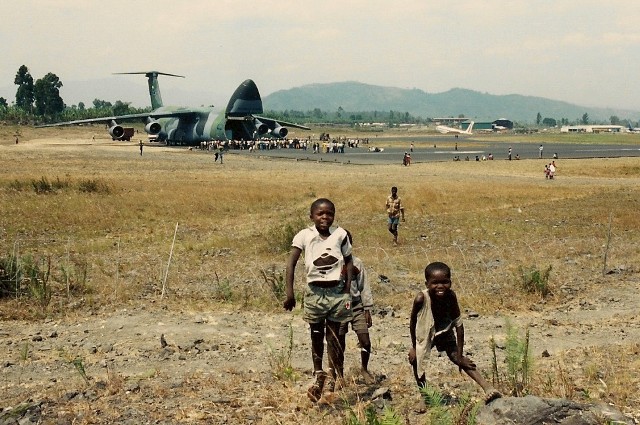
Residents of nearby makeshift villages gather as a U.S. Air Force Reserve crew based at Travis Air Force Base begins unloading water purification equipment in Goma, Zaire. The photo was taken in the summer of 1994 by Keith Michaud, a journalist covering the mission.

Residents of nearby makeshift villages gather as the C-5 Galaxy is unloaded. The transport was based at Travis Air Force Base in Northern California. Photo by Keith Michaud.

July 28, 1994 

Clashing with cholera

Travis delivery helps refugees in Zaire

(Reporter staff writer Keith Michaud and photographer Joel Rosenbaum accompanied Travis (Air Force Base) crews on their mission of mercy to Africa. Look for more of their reports this weekend in The Reporter. – Editor) 

 By Keith Michaud 

Staff Writer 

A C-5A Galaxy transport plane from Travis Air Force base delivered much-needed water purification equipment to Zaire on Tuesday, helping Rwandan refugees battle a deadly outbreak of cholera. 

By Wednesday, the equipment was working and delivering purified lake water to thousands of refugees in camps near the border town of Goma. 

The relief effort, however, was hampered by a lack of trucks to deliver water. United Nations officials were able to round up only two leaking, half-busted tanker trucks. 

U.N. organizers, overwhelmed by the crisis, said they were searching for tanker trucks in Zaire and shipping in about 10 tankers from Uganda and Croatia, but were able to rent only a few from gasoline shipping companies Wednesday. 

The Travis transport, manned by reserves from the 349the Airlift Mobility Wing, traveled for nearly 24 hours with at least three mid-air refuelings to deliver the water purification equipment and the seven-man crew from Portable Water Supply Systems. The Redwood City company set up an above-ground water system to pump 100,200 gallons of lake water every minute to eight water purifiers. 

Company owner Frank Blackburn said he and his crew will use two miles of hose to bring water from Lake Kibu, near Goma. Water there has been fouled by dead bodies and human excrement, worsening the cholera epidemic. 

Blackburn, a former San Francisco Fire Department assistant chief with 34 years experience in firefighting and disaster planning, said his company helped provide water during the Loma Prieta earthquake and the Oakland Hills firestorm. 

“This one is different because there’s a lot of people dying over here,” he said, aboard the C-5A. 

Blackburn’s son, Matthew, is with the crew. 

“For him, it’s a workshop,” Blackburn said of his son, a University of California, Davis, student studying international relations. 

Hundreds of refugees, French airmen, and U.N. representatives greeted the transport when it landed at the now-busy airport in Goma. Children scattered from the runway as the huge jet touched down. 

Not far away from where the plane was unloaded were two bodies and piles of rocks some said where graves. A member of the U.S. military assessment team said bodies also were outside the airport entrance, mostly because the airport is between the contaminated lake and a refugee camp. 

“Every day, a thousand more dead,” said French Air Force Capt. Jacques Albert Roussel. “It is terrible. In front of the (airport) there are dead.” 

Roussel and other French airmen have been in Zaire for a month. Roussel said the relief effort was a good thing. 

“It’s difficult, but a beautiful mission because we do it for them,” said Roussel, pointing to the hundreds of refugees gathering to see the transport. 

As the crew finished unloading equipment, a funeral procession moved from nearby huts, along the edge of the runway, behind palm trees. Children begged for money, business cards, to have their photograph taken, or anything American. 

U.S. Army Maj. Guy Shields, part of the military assessment team at Goma, said the purification equipment delivered Tuesday is much needed. “Those are going to make a big dent.” 

Shields said the local government and humanitarian groups were cooperating with the advance assessment team. He said one of the early problems was getting aircraft unloaded at the airport; at first planes were unloaded by hand. 

“The biggest thing here was to ease up on the congestion at the air field,” said Shields. “And the next thing was to bring in water.” 

U.S. Air Force Capt. David Burgess was helping deliver Red Cross supplies to Nairobi, Kenya, when he asked if someone was needed to assess the airport in Goma. That was seven days ago. 

After unloading the C-5A with a forklift, Burgess estimated he had unloaded 300 tons during the previous 30 hours from all sorts of aircraft arriving from different countries. 

A tired Burgess said, “I’ve seen the refugee camps. I’ve seen the mass graves. I’ve seen funeral processions like the one we just saw. We need more help here. 

“The bodies stacked like cord wood. … It really gets to you.” 

Two children from the nearby makeshift villages ham it up for a couple of journalists from the United States. In the background are what locals said were burial mounds. The children were playing on the mounds. Photo by Keith Michaud.
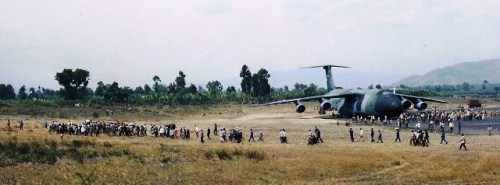
A funeral procession makes it way not far from a C-5 Galaxy transport jet being unloaded of water purification equipment at the Goma, Zaire, airstrip in the summer of 1994. Photo by Keith Michaud.

August 2, 1994 

Grim images of refugees haunt helpers

(Today’s edition of The Reporter features the efforts of staff writer Keith Michaud and photographer Joel Rosenbaum. The pair accompanied Travis (Air Force Base) crews on a mission of mercy as they delivered water purification equipment to a Rwandan refugee camp in Goma, Zaire. – Editor) 

By Keith Michaud 

Staff Writer 

The images of Goma, Zaire, go beyond frightening. The go beyond haunting. 

On a hill overlooking the airstrip, two small bodies lay side-by-side, their faces and most of their thin bodies covered with a cloth. 

A small child – perhaps 5 years old – sat on one of the nearby rock piles in a makeshift graveyard with graves of all sizes, from adult to small child. 

As the first of the U.S. Air Force transports finished unloading water purification equipment a week ago for thousands of Rwandans dying from cholera and other diseases, a funeral procession came from behind a dirt berm nearly concealing shanty huts. 

The procession, complete with 100 or more singing mourners, made its way around one end of the runway where the C-5A Galaxy jet from Travis Air Base in Fairfield was being unloaded. It then moved into a grove of nearby palm trees. 

Despite the muggy haze, Mount Kilimanjaro could be seen from miles away, a backdrop to the airport, the camps and the horror. 

Relief workers said bodies of more dead were along the road just outside the airport gate, the same road used by refugees to travel from the camps to Lake Kivu, which is contaminated by dead bodies and human waste. 

These, by far, are not the worst scenes from the tragedy that has come from a Rwandan civil war that has already killed hundreds of thousands and left tens of thousands dying in refugee camps. 

But each image of death, each image of suffering, each image of the atrocities in Rwanda and surrounding countries adds to a pile of horrific woes stacked far higher than stones piled on top of the graves. 

Air Force Capt. David Burgess arrived in Goma, Zaire, five days before the Travis jet. 

Flying humanitarian aid to Nairobi, Kenya, Burgess volunteered to fly to the tiny airstrip to assess the airport for the expected flights bring aid to the ravaged countries. 

I’ve seen the refugee camps. I’ve seen the mass graves. I’ve seen funeral processions like the one we just saw. We need more help here,” said Burgess, weary from nearly single-handedly unloading transport aircraft early last week with a lone forklift. 

Other transports, he said, were unloaded by hand. 

“The bodies stacked like cordwood. … It really gets to you,” he added. 

Hundreds of refugees gathered around the Travis jet, making it difficult for Burgess to unload. The onlookers, mostly small boys and men, crowded in on the jet, its Air Force reserve crew and media representatives accompanying the humanitarian mission. 

The men, speaking broken English and passable French, asked for help, any help. The mostly begged for money. 

The children also begged for money, but some were happy just to have their photograph taken. Some children wearing little more than rags walked arm-in-arm, apparently with no surviving adults to supervise them. 

It is estimated that some 2 million Rwandans left their homes and their crops to flee to Zaire, and hundreds of thousands of others fled to Tanzania, Burundi and Uganda. 

By the end of the week, many refugees began returning to their homes despite the continued threat of violence there. Relief workers were trying to set up food stations along the road back to Rwanda to encourage refugees to return home and away from the deadly camps. 

The suffering prompted a U.S.-led rescue effort on a massive scale. The U.S. military called upon reserves – its “weekend warriors” – for a peaceful mission. 

The C-5A Galaxy carrying water purification equipment from a Redwood City company, Portable Water Supply System, was flown nearly 24 hours straight from Travis Air Force Base to the airport in Goma, Zaire. The flight, because of its length, required twice the normal crew from the 349th Air Mobility Wing and three mid-air refuelings. 

Now flights are taking off from military bases in Europe on their way to Africa. 

One of the pilots, Lt. Col. John Jackson of Benicia, has been in the reserves at Travis the past 15 years, with 10 years active duty before that. Jackson has flown scores of humanitarian and emergency missions, but delivering the water purification equipment had a special meaning. 

“You couldn’t get much more humanitarian than that,” said Jackson. “We want to help provide a safe water supply.” 

Portable Water Supply System was up and running within 24 hours, helping provide hundreds of thousands of gallons of drinking water. With more equipment expected, the water was but a fraction of what was needed and relief workers were unable to get much of the water to the refugees because of leaky tankers. 

“It’s much more satisfying to do these types of missions,” said Jackson, who is a Hawaiian Airlines pilot away from the reserves. “It’s nicer to try to save somebody than it is to go to war with somebody.” 

Jackson’s co-pilot, 1st Lt. Greg Chrisman of Burlingame said, “From a personal level, it’s pretty easy to read a newspaper or watch TV and see what’s happening. … I don’t even think we can imagine the severity of the situation. 

“When they called and said they needed people, that was part of my commitment (to the Reserves). I wanted to go,” said Chrisman, who flies for Southwest Airlines. 

Jackson and Chrisman over the years have flown missions to Desert Storm and Somalia, and have helped relief efforts after hurricanes and other natural disasters. 

Tech. Sgt. Alice Munoz, of Vacaville, has more than 14 years in active and reserve duty. A correctional officer at California State Prison, Solano in Vacaville, Munoz is a flight engineer. 

Except for the flight surgeon, she was the only woman on the reserve crew flying the equipment to Goma. 

“I’m very patriotic,” said Munoz, “so whatever the Air Force has for me, I’m willing to help out. 

I treat all missions the same way because you never know what’s going to happen.” 

Munoz was not the only crew member from Vacaville. Lt. Col. Phillip P. Blackburn, Mast Sgt. Wendell K. Asato, and Staff Sgt. Roderick J. Rodda, all of Vacaville, were also on the crew, with Staff Sgt. Robert T. Selmer of Fairfield. 

The crew members mentioned that their employers willingly allowed them to take off time for the mission, mostly because of the images shown over the past weeks. 

“I think they were more excited about it than I was,” Munoz said of her supervisors at the prison. “I think they know what’s going on over (in Rwanda and Zaire).” 

[The following is a column I was allowed to write at The Reporter after I returned. I believe it was published on or about the same time as the story immediately above, but I cannot find the date on the clipping I have of the column. This column was written prior to being given a regular weekly column at The Reporter. – KM] 
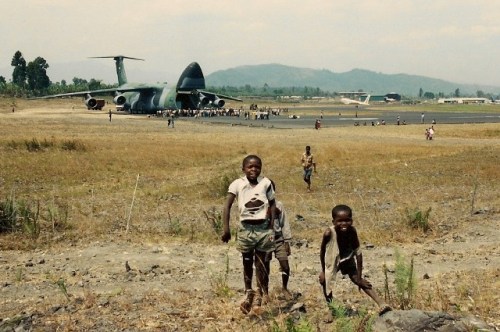
Two children from a nearby makeshift village play and ham it up for journalists as water purification equipment is unloaded from a C-5 Galaxy transport based at Travis Air Force Base in the summer of 1994. Children from the villages near the Goma, Zaire, airstrip made a game out of running into jet wash as a plane landed. The force of the wash would lift them into the air. Photo by Keith Michaud

Unshakeable images

 It’s hard to shake the things you see in Goma, Zaire. 

A week back from the trip with an Air Force Reserve flight to a tiny airstrip to deliver water purification equipment, I still don’t sleep as well, eat as well or think as well as I did before visiting that place. 

Maybe it’s jet lag. Maybe it’s the malaria pills I must take for another couple of weeks. Maybe it’s just what I saw there. 

Even though it was just an African airport and not the disease plagued refugee camps, it changed my perspective on the world and what’s important. 

We Americans are quick – too quick – to complain about the very little of things. We complain if we don’t have clean underwear. We complain if a flight home is not on time. We complain about being a couple bucks sort. 

What do Rwandan refugees have to complain about? 

They have life and death. Lately, they’ve had mostly death. 

When all the bodies are totaled, there could be 750,000 to 1 million dead between the civil war in Rwanda and the disease in refugee camps in neighboring countries. Many of those camps are around Goma. 

There’s a surreal quality to the Goma airstrip. As the C-5A Galaxy from Travis Air Force Base came in low for the landing, young children scurried out of the jet’s path, many knocked over by the wash. It’s a little game they play in Goma. 

A fence of rolled barbed wire goes around a least part of the airfield. But there are large holes in the fence and it’s fairly easy for refugees camped not far away to make it to the end of the runway to see the big jet as it is being unloaded. 

Americans complain about being overweight and being unable to stick to diets. There were no overweight people at the Goma airstrip. There were a few bloated stomachs, though. 

The airstrip there is in a bit of a basin with patches of green and lush hills nearby. Mount Kilimanjaro from miles away peers down through the thick, hazy African sky. 

Just beyond the rolled barbed wire were two thin bodies, barely covered with a cloth. Refugees from nearby shanty camps walked by with bundles heaped high on their heads; most barely looked at the bodies. To them, the bodies were just two more of so many. 

And just beyond were more signs of death in Goma: stones piled up for graves of all sizes. Children play among the piled stones. 

As the crew finished unloading the huge jet, a funeral procession went by. More death. 

It’s not difficult to imagine the bodies. U.S. and French military officers talked about the road just outside the airport. Men hardened by training, expectations and experience, they still become choked up when they talked about bodies stacked like cordwood. 

But among the images of death, there are still those glimmers of hope. The water purification equipment was up and running within 24 hours. It was enough to give only a small portion of the refugees clean water, but it was a start. 
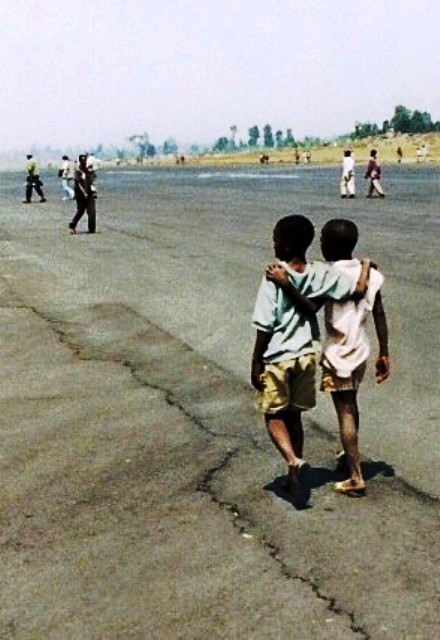
Two children walk down the runway at the Goma, Zaire, airstrip in the summer of 1994.

And children still play in Africa. They still walk arm-in-arm. They still mug it up for a camera. Children die in the refugee camps, but children are children and they play until they are too ill to play. 

It’s not the Africa I saw as a kid in Tarzan movies. It’s an Africa that likely will continue tearing itself apart with tribal wars – wars that will continue to leave hundreds of thousands of people vulnerable. 

News stories compared the death and living conditions to hell and the first days of the Apocalypse. That seems close to the truth. 

The author was a staff writer for The Reporter when this column was published. 

Portland’s proposed pot dispensary moratorium meets opposition | Maine Public Broadcasting Network

Portland’s proposed pot dispensary moratorium meets opposition | Maine Public Broadcasting Network

Remembering just how very important fishing is to me and ME: Part 1

News stories and blogs on Maine’s major media websites not long ago reminded me just how every important fish and fishing are to me and Maine.

I’m not talking about commercial fishing. Commercial fishing in Maine is huge. In Maine, fishing is a way of life and enormous to the economy of the entire state. Fish is king in Maine.

What I’m talking about instead is the kind of fishing I learned as a kid – sports fishing and fishing for sustenance on inland waterways. The fishing I learned was a rite of passage and an outdoors activity to feed the body and soul.

And the mosquitoes and black flies, but that’s a different blog entry.

Stories on the websites of the Bangor Daily News, Portland Press Herald and Down East magazine were big in reminding me about the importance of fishing to socialization, culture, and heritage in Maine.

By rough estimates, I started fishing 40 years ago. And while I haven’t had the opportunity to wet a line in recent years, it remains central to the person I was, the person I am, and, I suspect, the person I will become.

No, this is not a story to match “A River Runs Through It,” the novel and subsequent movie that told of lives and deaths and the lessons learned by fishing a river.

Frighteningly, invasive species are crowding native species from Maine’s streams, ponds, and lakes.

The story of inland fishing is a bit murky. There is some hope and more than a bit of concern.

A Portland Press Herald story told of an effort to restore an ancient fish, the Arctic char, in Big Reed Pond. It is “ancient” because biologists believe the fish has been here since the last ice age. That’s not just your my-bones-hurt-and-feel-ancient sort of ancient. That is seriously ancient.

The problem for the orange-colored char started when a well-meaning sports fisherman introduced rainbow smelt in the water as way to provide more food for the char. But that backfired when the smelt ate small char and the char’s food.

But a state wildlife biologists, a private fishery, local lodge owners, and grants from Maine Outdoor Heritage Fund are slowly making the future brighter for the Arctic char.

George Smith’s DownEast.com blog some time ago focused on fishing. One titled “The battle between natives and those ‘from away’” especially caught my attention, of course, for its use of “from away.” After all, this blog is titled “Letters From Away.”

But I became far more interested in what he had to write about native fish and those that have been illegally or inadvertently introduced into Maine waters than I was with his use of the Mainer phrase for anything not of or from Maine.

Wildlife officials from Maine to California and many other areas in between are facing similar problems – non-native fish and other aquatic life being introduced into waterways and those species forcing out native fish and other aquatic life. Some are introduced by accident when carried on a boat or other gear that was not properly washed down or intentionally introduced by so-called sportsmen believing it would be good to have, say, bass or walleye in a trout habitat. I even found a story about a koi being pulled from a Maine pond. Koi?!

Either way, native species should be given a chance to survive and thrive in their natural habitat.

Here’s something from the U.S. Fish and Wildlife Service’s website on invasive species:

Invasive species are organisms that are introduced into a non-native ecosystem and which cause, or are likely to cause, harm to the economy, environment or human health. It is important to note that when we talk about a species being invasive, we are talking about environmental boundaries, not political ones. In addition to the many invasive species from outside the U.S., there are many species from within the U.S. that are invasive in other parts of the country.

The U.S. Fish and Wildlife Service is the only agency of the U.S. Government whose primary responsibility is the conservation of the nation’s fish, wildlife, and plants. Because of our responsibilities, the Service is very concerned about the impacts that invasive species are having across the Nation. Invasive plants and animals have many impacts on fish and wildlife resources. Invasive species degrade, change or displace native habitats and compete with our native wildlife and are thus harmful to our fish, wildlife and plant resources.

The website also provides FAQs, resources, laws, and other information.

The Maine Department of Inland Fisheries and Wildlife also has quite a bit of information. Follow this link and click on “Illegal Fish Stocking” for specific information. There is also information about invasive aquatic plants.

Here are links to some of those stories and blog entries.

The battle between natives and those ‘from away’ | DownEast.com

Sound science produces good Maine fisheries | DownEast.com

Restoration raises hope for future of native fish | Portland Press Herald/Maine Sunday Telegram

Salmon return in record numbers: Experts ‘cautiously optimistic’ about high figures | Bangor Daily News

Invasive species threatening Maine waters: DIF&W says illegally introduced fish could disrupt ecosystems, local fisheries | Bangor Daily News

Bookmark and Share

What? Your job is to help people find jobs?!

Here’s a little irony for you … well, quite a bit of irony, actually.

I’ve been looking for work for the past 15 months. After 22 years in the newspaper business, I was laid off. Over the course of that 22 years I have been a reporter, columnist, copy editor, assistant news editor, opinion page editor, assistant city editor, website staff writer, and blogger. I’ve been trying to find work, usually via online job boards and websites, networking via friends, LinkedIn and Facebook, and by simply keeping my ear to the ground.

I’ve been pretty open about the experience. At least, with my family, friends, and those of you who have visited “Letters From Away.” I’ve written about the frustration of the job search and the various pitfalls that have occurred in the past 15 months.

But I wasn’t very open with the other tenants of my apartment building. I don’t know any of them very well and I felt uncomfortable opening up about that sort of thing. And apparently some of them have not caught onto my blog, if you can believe that.

Anyway, I was walking down to the basement garage on Saturday when a guy who lives in one of the downstairs apartments came out.

“So, where are you working now?”

“I’m not,” I replied.

“What?!”

“Yeah, today makes 15 months since I was laid off,” I informed him. A mix of surprise and shock flashed over his face.

“Listen, I think I can help. …”

I’ve been living in the same apartment building since late 2006 and out of work since March 5, 2009, and I had no idea that my neighbor worked for a county agency that helps people get back to work. One of the programs for which I may be eligible is a six-month, 50 percent salary grant where an employer would be reimbursed for 50 percent of a worker’s salary for six months.

That does a couple of things, of course. It gets workers into jobs, it gives the employer a worker and a chance to see what the employee can do to prove himself or herself in a job and it gives a little time for the economy a little time to come around so that at the end of the six months the employee has a better chance to be held on permanently.

 I’m not exactly sure what else the neighbor or the agency can do to help me, but I have an appointment to talk with the guy tomorrow.

Slamming down the cell phone to make a point and other technological oddities

I’ve had a cell phone for years now, but every so often I still listen for a dial tone before punching in the number I’m calling.

I know, it’s crazy, but I still do it.

Everyone knows that you punch in the number and then hit the Call button to initiate cell phone call. There is no dial tone, as there is with landline phones.

But old habits die hard. It’s what we all do with landline phones, after all.

Take slamming down a phone in anger to make a clear point that the telephone conversation has been terminated. You can’t do that with a cell phone or you’d end up with a bunch of bits and pieces.

Cell phone manufacturers should make a slam-the-phone-down function. You hit a button on your cell phone and the person on the other end hears a loud click and the call is then terminated.

However, I must say, the idea of ending a cell phone call and imagining the person on the other end continuing the conversation even though you’re not listening anymore is a bit fun, too.

Here’s another thing that I blame on technology for making me look silly. When I was working and after a particularly long day, I would – wait for it – hit the unlock button on my car alarm fob in an attempt to gain entry into my apartment. Yep, I tried to unlock my apartment door by unlocking my vehicle door.

I’m not proud, but it is the level to which technology has reduced me.

Bookmark and Share

Coffeehouse observation No. 144

Just spotted a guy outside the coffeehouse take a yard-long stick, scrape up something gooey from the sidewalk, and stare at it for minutes with an expression of total pleasure and wonderment on his face.  Imagine, bliss found in discarded gum at the end of a stick.

Go to Coffeehouse Observer for more coffeehouse observations.

Bookmark and Share

Coffeehouse observation No. 143

It’s bright and sunny out for the first time in years – or so it seems. I’m inside a nice cool, dim coffeehouse enjoying a Red Eye before continuing the job search. Have a lovely Memorial Day weekend everyone. … And don’t forget that this weekend is to remember those who have fallen in defense of this country. It’s not just about burgers and hot dogs.

Go to Coffeehouse Observer for more coffeehouse observations.

Bookmark and Share

Maine organic farmers launch grain mill | Lewiston Sun Journal

Maine organic farmers launch grain mill | Lewiston Sun Journal

Waste knot: Toxic threat on banks of the Penobscot | Portland Press Herald

ORRINGTON – At this time of year, the Penobscot River flows dark and deep, draining the second-largest watershed in New England – and one of the most pristine.

But as the river passes through the town of Orrington, it picks up an added ingredient: mercury leaking from five landfills on the riverbank at the former HoltraChem Manufacturing Co. plant. The polluted water then flows past Bucksport and into Penobscot Bay, past the coastal tourist towns of Castine, Camden and Rockland, the big summer homes on the islands of Islesboro, North Haven and Vinalhaven, and into the fishing grounds of the Gulf of Maine.

“This is not just an Orrington issue. This river is so valuable to Maine’s economy,” said Ryan Tipping-Spitz of Bangor, an organizer with the Maine People’s Alliance, an advocacy group that has been pushing for a cleanup at HoltraChem for decades.

The mercury contamination at the plant, once described by Gov. John Baldacci as the worst hazardous waste site in the state, has been the focus of a cleanup effort dating to the 1980s.

Click on the link for the rest of today’s story by Beth Quimby in the Portland Press Herald.

EPA report tracks 24 climate change Indicators | SustainableBusiness.com News

Heat waves, storms, sea levels, glaciers, and wildlife migrations are just a few of the environmental indicators that show measurable signs of climate change, according to a new Environmental Protection Agency (EPA) report.

“Climate Change Indicators in the United States,” looks at 24 key indicators that show how climate change impacts the health and environment of the nation’s citizens.

Click on the link for the rest of this press release by SustainableBusiness.com.

Cape Wind receives federal approval for first offshore wind farm | SustainableBusiness.com News

Secretary of the Interior Ken Salazar on Wednesday approved the Cape Wind offshore wind farm, completing the last regulatory step for the project which was first propsed for Nantucket Sound about eight years ago. 

The project has been delayed throughout the permitting process by opposition from coastal residents who fear the wind turbines, which will be erected five miles from shore, will devalue coastal properties and affect tourism.

Salzar said the developer of the $1 billion wind farm must agree to additional measures to minimize the potential adverse impacts of construction and operation of the facility.

“After careful consideration of all the concerns expressed during the lengthy review and consultation process and thorough analyses of the many factors involved, I find that the public benefits weigh in favor of approving the Cape Wind project at the Horseshoe Shoal location,” Salazar said in an announcement at the State House in Boston. “With this decision we are beginning a new direction in our Nation’s energy future, ushering in America’s first offshore wind energy facility and opening a new chapter in the history of this region.”

The Cape Wind project is expected to be the first wind farm on the U.S. Outer Continental Shelf, generating enough power to meet 75 percent of the electricity demand for Cape Cod, Martha’s Vineyard and Nantucket Island combined.

Click on the link to read the rest of the SustainableBusiness.com press release.

Solar Plane Completes First Flight

Solar Plane Completes First Flight

Posted using ShareThis

Opening delight for Red Sox Nation | The Portland Press Herald / Maine Sunday Telegram

Opening delight for Sox | The Portland Press Herald / Maine Sunday Telegram.

Maine in-laws see ex-Angel in a new light | The Portland Press Herald / Maine Sunday Telegram

Maine in-laws see ex-Angel in a new light | The Portland Press Herald / Maine Sunday Telegram.

Red Sox Preview: Teetering on greatness | The Portland Press Herald / Maine Sunday Telegram

Red Sox Preview: Teetering on greatness | The Portland Press Herald / Maine Sunday Telegram.