Category Archives: Uncategorized

Just say cheese … photos are welcome!

If you have a photo that was taken in Maine, New England or is related in some way to Maine or New England, please feel free to e-mail to me an electronic version and I will post it here. That includes photos of Mainers visiting those of us “from away” or those of use “from away” visiting home.

WordPress allows images in jpg, jpeg, png, gif, pdf, doc, ppt, odt, pptx and docx, although I am most comfortable dealing with jpgs and jpeg.

Be sure to send information about the photo such as when and where it was taken, who or what is in the image, a story about how and why the photo was taken … that sort of thing. I will most likely include the story, and if I know people or places in the photo or something about the location, I may add a comment, too.

And above all, only send photos to which you have a right – as in copyright – and/or permission to use. Do NOT send along photos that are copyrighted or to which you do not have permission to use. Do NOT send along photos copied from the Internet, because many of those are copyrighted.

With a little luck, I hope to post a few photos a week to add a little eye-candy.

Shake, rattle and roll in western Maine

California and other Pacific Rim areas usually are the first to come to mind when talking about earthquakes, not Maine or the rest of New England.

The Weston Observatory and the New England Seismic Network say there was a 2.5 magnitude quake about 2 a.m. (EST) near Andover about 7 miles northwest of downtown Rumford, Maine, according to the Associated Press story on the Lewiston Sun Journal website. (The NESN should not be confused with the New England Sports Network, which also goes by the acronym NESN.)

I have been through several earthquakes since moving to California in 1983, including the 6.9 magnitude Loma Prieta quake in 1989, but the very first temblor I felt was as a child living in Maine. It did not shake me out of bed, but it did wake me suddenly. I seem to recall that the quake’s epicenter was along a fault under the St. Lawrence Seaway.

At 2.5 magnitude, there was no damage and most people seemed to have slept right through it.

There is some interesting information about earthquakes on the East Coast on both the U.S. Geological Survey and Maine Geological Survey websites, including general history and a timeline of major temblors.

New England is good for your health

A nonprofit health agency says that all six New England states are among the top 10 healthiest states in the country, Forbes.com reported today.

But New Englanders probably knew that.

Vermont took the No. 1 spot in the latest annual ranking by United Health Foundation, which Forbes.com pointed out is funded by insurer UnitedHealth Group. The rankings are based on 22 health indicators, including vaccinations, obesity, smoking, and cancer deaths. And details about each state can be found on the foundation’s website, but the website is not for the patient and some of the links in this entry may be sluggish.

“Vermont ranked first this year thanks in part to its low rate of obesity, high number of doctors and a low rate of child poverty,” wrote Forbes.com’s Rebecca Ruiz. “New England in general sets a benchmark for the country, the report found: All six New England states are in the top 10. These states have favorable demographics and an excellent public health infrastructure, including a large number of doctors per capita.”

Massachusetts was at No. 3; New Hampshire at No. 5; Connecticut at No. 7; Maine at No. 9; and Rhode Island at No. 10. (Maine moved up from No. 12 a year ago.)

By comparison, my current home state of California ranked No. 23, and neighboring states Oregon ranked No. 13; Arizona ranked No. 27; and Nevada ranked No. 45.

Connecting dots from Fryeburg to the northern boundary

It is amazing sometimes how things just sort of fit together in a weird cosmic sort of way. Today, I am able to connect the dots between Maine’s first-ever school, a leading pre-Civil War politician, and some wily northern Mainers who wanted to avoid British rule.

I am a Facebook fan of DownEast magazine, the Maine-base monthly publication that carries stories, commentary, Maine humor and more. The magazine today posted a trivia question about Fryeburg Academy, the first school built in Maine and the school where my sister and brother-in-law intend to send my niece and nephew. The history is rich. John Hancock – yeah, the “place your John Hancock on the dotted line” John Hancock – signed the charter for the school in Fryeburg, Maine, in 1792. Yeah, 1792. There are some pretty old things in Maine and the rest of New England.

Anyway, the trivia question was about the academy’s most famous headmaster. Turns out it was Daniel Webster, a leading American politician before the Civil War.

OK, I know that might not impress anyone other than people into pre-Civil War U.S. history, but I found it interesting. The answer that DownEast gave was: “Daniel Webster, politician, pundit, and hard-drinking diplomat who settled the northern border of Maine over a bottle of brandy with a British negotiator.”

The last part of the answer caught my eye, too, since I was born on that northern border and lived my entire childhood about an hour’s drive south of it. It also reminded me of a story my Ashland Community High School history teacher, Ron Stevens, told class one day. If I recall correctly, surveyors were sent to establish the boundary after the agreement between Daniel Webster and the British negotiators. The surveyors reached the confluence of two rivers and the locals – my Mother has relatives there – invited the surveyors to partake in “adult beverages.” The locals then sent the surveyors on a northern tributary of a river rather than the southern route agreed upon by Webster and the British negotiator over that bottle of brandy.

Anyway, once the surveyors sobered up and realized they had been sent down the wrong river, instead of backtracking, they simply put down two straight surveyors lines to reconnect with the route set in the agreement. If you look at the northwest portion of the state of Maine on a map you can pretty much see where the surveyors were steered down the wrong river and where they decided it was best to make it back to the established route. It also means several thousands of acres of land more for Maine.

See, weird cosmic sort of way to connect some dots between the oldest school in Maine, a leading politician and the state’s northern most boundary.

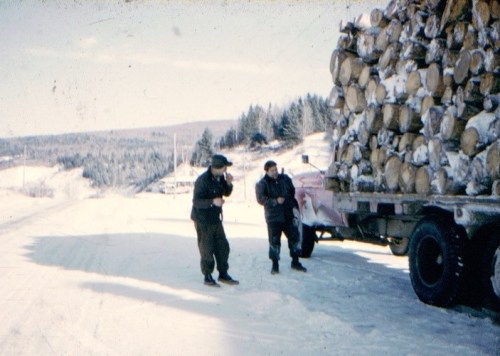
Updated 11/13: Uncle Clayton hauling pulp near St. Francis

Phillip Thibodeau (left) and Clayton Jandreau.

Phillip Thibodeau (left) and Clayton Jandreau standing near a truck hauling pulp.

I knew this day would come – a correction. Mickey Thibodeau took the photo of my Uncle Clayton Jandreau next to his new truck, a 1960 model, in the winter of 1960-61 in the street in front of his family’s home not too far from where my Uncle Clayton, my Mom and their siblings grew up in St. Francis, Maine. Mr. Thibodeau’s father, Phillip, is standing with my uncle. Mr. Thibodeau did not receive the photo from my cousin.

[Posted November 12, 2009 (See correction above): I wanted to get this photo up. I will post more later on it. The photo was e-mailed to me from another Mainer “from away,” Mickey Thibodeau, who now lives in Lake County, California. Actually, the photo comes from Mr. Thibodeau who received it from my cousin Cindy Jandreau. (Yep, the moose hunter.) The photo, taken in St. Francis toward Allagash, shows Mr. Thibodeau’s father, Phillip, and Clayton Jandreau (nearest truck), an uncle to Cindy and me. I am not sure when the photo was taken, but I am guess it had to be in the 1950s or ’60s.]

As I recall from family tales, one of the things my Grandfather and uncles did to get by was cut pulp to be used in mills. They used horses to haul the pulp from the woods to sidings or the nearest road where it was loaded – I am assuming usually loaded by hand – onto a truck to be taken to the mills. Of course, pulp is used for paper and other products.

I seem to recall a story my mother told me once that one of the horses they used to haul the pulp broke loose and was racing toward my Mom, who was pretty young at the time. If I recall the story correctly, one of her brothers threw her behind a fallen tree and the horse leaped over them and the fallen tree. It must have been a pretty exciting time for a little kid.

Mr. Thibodeau also mentioned an old parish hall in St. Francis my Uncle Warren – Clayton and my Mom’s brother and Cindy the Moose Hunter’s father – own and subsequently tore down. He later built a home there for himself, his wife Monica and their children.

I seem to recall that for a time – perhaps between when the building was used as a parish hall and when my Uncle Warren tore it down – that he ran a couple of businesses, including a barbershop and a pool hall/pinball parlor. I recall seeing photos of my first haircut and I am pretty sure Uncle Warren handled the shears that day. If the photos are any indication, I was not particularly pleased to get my hair trimmed.

For those who are unfamiliar with where St. Francis is located, it is on the border with Canada near where the St. Francis and St. John rivers meet. If you look at a map of the state, St. Francis is in the large notch at the northern border. Allagash, where the Allagash Wilderness Waterway ends to the north, is east of St. Francis. Fort Kent, Maine, to the east is where I was born.

Another pitch for ‘The Way We Get By’

The Way We Get By - Click to Watch the Trailer

I figured I would make one more pitch for the PBS POV documentary on the Maine Greeters, a volunteer group whose members hand out smiles, handshakes, cookies and cellphones to U.S. servicemen and women going to or returning from Iraq and Afghanistan via the airport in Bangor, Maine. Day or night they are there to greet the servicemen and women.

The documentary — “The Way We Get By” — is about aging as much as it is about the servicesmen and women, because the group’s members tend to be elderly and are facing their own battles.

Check local PBS listings for times. If you miss it tonight, I believe it can be viewed on the POV website for the next month or so.

Friendship a bit better with wine, beer

You gotta love this story.

Voters in a Maine coastal town, one that has been bone dry since 1919, voted to allow the sales of beer and wine. Not liquor and not on Sundays, but it is a start for Friendship, Maine.

Years ago I was the best man in a wedding held in Texas. I am not sure how it is today, but I seem to recall that we had to drive into Arkansas to buy beer because we were staying in a dry county. I toasted the bride and groom with iced tea because the rehearsal dinner was in a dry county.

Years later I was the best man in another wedding. It was not in a dry county. That was better.

One-room school on Maine island

At a time when school districts in California and elsewhere are increasing the number of students in classrooms and closing down schools because of low enrollment (really, that’s not an oxymoron), this Portland Press Herald story about a one-room schoolhouse on a Maine island struck me as interesting. In many ways, this is a portrait of how beautifully simple life in Maine can be.

The Cliff Island School – I believe the story said it was one of five one-room schools in Maine and one of 200 left in the nation – has a handful of students. The islanders and school district worry that the school will be forced to close once a couple students graduate to a middle school on a different island. The district might not be able to justify the cost of the school if more families with school-age students do not move to the island.  

According to the story, the cost of running the school is pretty high, but transferring the students to another school brings up certain planning and safety issues since it would mean ferry rides to the mainland and then a ferry ride to a different island for the school. That would mean ferry rides in some pretty foul weather some days.

A husband and wife make up the teaching team and it appears from the story and accompanying video that it is an idyllic educational and social situation for the children and the community. If I had children I would want them to experience something like this for at least a couple of years.

The first four or five years of my education were at the school in Portage not far from the center of town. It was a bit larger than the school in the story. There were four classrooms, although only three were used for regular classes with two grades in each classroom. The fourth classroom, as I recall, was used for special education, art classes and that sort of thing. There was a multi-use area where we had lunch and where we had recess if the weather was bad outside; it was northern Maine so the weather was pretty bad more than a couple times in a school year. As I recall to my friends who grew up in warmer climates, I walked to school in the snow up hill … both ways.

Outside there was a playground and a softball field. In the winter, plows would push back huge snow banks – at least they seemed huge to grade-schoolers – we would use for forts and playing king-of-the-mountain.

Looking back, it was a pretty good experience going to school there.

They closed down the school years and years ago and I believe the building is now the town offices.

This fits me: ‘Born in Maine, living in exile’

There is a subtle bite to the humor in New England and Maine especially. It comes from working hard and living in a fairly harsh climate.

And Mainers suffer no fools, as you might imagine. Why should they?

There are even times when the humor is served up with such skill that a person does not realize he has been made the center of a joke until he has walked away from the Mainer who administer the dig and replayed the experience from start to finish.

Being from away, I appreciate the products found on the Maine Exile Products website, including T-shirts, mugs and alike with the message: “Born in Maine. Living in exile.”

The website home page also has a tongue-in-cheek quote from New England writer Louise Dickinson Rich that pretty much sums up the feelings of a Mainer “from away”:

“Mainiacs away from Maine are truly displaced persons, only half alive, only half aware of their immediate surroundings. Their inner attention is always preoccupied and pre-empted by the tiny pinpoint on the face of the globe called Down East. They try to live not in such a manner that they will eventually be welcomed into Paradise, but only so that someday they can go home to Maine.” – Louise Dickinson Rich. (By the way, the term “Mainiacs” is a little something Mainers call themselves.)

More Maine fun to come.

Same-sex marriage law in Maine should stand

Question 1 on the Maine state ballot Tuesday reads: “Do you want to reject the new law that lets same-sex couples marry and allows individuals and religious groups to refuse to perform these marriages?”

No one “from away” is going to change any Maine voter’s mind when it comes to same-sex marriage and Question 1 on Tuesday’s state ballot. Maine voters by now have made up their minds about the issue and know which oval they plan to fill in. Mainers are an independent lot and they – rightfully so – should not cotton to outsiders interfering in their business, especially at this late date.

And perhaps I should just keep my pie-hole shut given that I do not have a vote in the state of Maine.

But here I go anyway. Gays and lesbians should be allowed to marry and be given all the rights, privileges and comforts that any married man and woman currently enjoy. This is about a civil right. This is about a human right. This is about fairness and equality. This is about what is right.

Maine’s same-sex marriage law was enacted earlier this year with Maine Gov. John Baldacci’s signature of state legislation and it should stand as Maine law. (Read Gov. Baldacci’s statement on the same-sex marriage bill, as reported by the Portland Press-Herald.) Backers of Question 1 want voters to reject the law that essentially undoes earlier discrimination and injustice.

Here is why some of the pro-Question 1 arguments do not stand up:

The education thing: The anti-same-sex marriage camp made much about how allowing the law to stand would mean that state schoolchildren would be given lessons about gay and lesbian lifestyles. It is a false statement and should not be believed. The state attorney general already has ruled that it would not have an effect on state curriculum. So let us move on, shall we.

The marriage-is-for-man-and-woman-only thing: There is no doubt that traditional marriage has been between one man and one woman. But traditions do not start out as traditions. Every tradition begins with a starting point or first event. And, let’s face it, traditions change over time. They morph and shift and sometimes they are simply lost due to disinterest or shifting ideals.

But marriage is not a tradition that is being lost due to a lack of interest. Quite the opposite, because gays and lesbians want to marry, they want to take part in a tradition that shows to the world that two people intend to be bonded for life.

Besides, what is the basis of a marriage? Is it not about two people who truly love each other and are in a caring, committed relationship to the point of wanting to formalize the bond? It is sort of like shouting to the world that two people plan to share their lives now and well into the future – but with paperwork. Does it really, really matter if the two people are a man and woman, two women or two men?

Approving Question 1 is essentially saying that two people in love cannot be together for life in a marriage simply because they were born gay or lesbian. It would be akin to determining that people of different races or social caste could not marry simply because they were of different races or came from different social rankings. Most states got rid of those laws long ago. Except in situations in which the people involved are underage or lack the mental capacity to understand the significance of entering a marriage or are already in a marriage, we as a society should stay out of legislating love.

And allowing the law to stand is not discriminating against men and women who are married, as one friend suggested. In fact, reversing the law would be discriminating against people who want nothing more than to enter a lifelong, committed relationship, just as men and women are allowed to do.

Listen, we heterosexuals have not exactly given marriage a good name. After all, about half of marriages are failures. Perhaps it is time to allow committed, loving gays and lesbians to marry to help boost the numbers of successful marriages. It’s just a thought.

The God thing: Marriage is a sacred union currently reserved only for couples made up of a man and a woman. And all other unions involving same-sex couples are viewed by many as unnatural, immoral, and even the work of Satan. I believe in God, but I am not a churchgoer. The God I know loves His or Her creations, no matter a person’s sexual orientation. Gays and lesbians believe in God. Gays and lesbians attend church and worship God. Gays and lesbians are clergy and church leaders. God is not rejecting gays and lesbians; people who dare to claim they know what God intended are rejecting gays and lesbians.

One of the early anti-same-sex marriage concerns was that churches would be forced to conduct marriages for same-sex couples. Plainly, that is addressed in the law since Question 1 reads: “Do you want to reject the new law that lets same-sex couples marry and allows individuals and religious groups to refuse to perform these marriages?”

The gay or lesbian you know thing: I have been in California a quarter century and in that time I have come in contact with gays and lesbians in work and social situations. But I also came in contact with gays and lesbians in Maine before coming to California. Gays and lesbians live normal lives – they work, play, raise families, pay taxes, and go to restaurants, movie theaters and the mall – except they cannot marry.

Gays and lesbians are in every walk of life and whether a person knows it or not, it is highly likely that they have a gay or lesbian family member, friend, co-worker or acquaintance. Every extended family – and perhaps every immediate family – is going to have a member who is gay or lesbian. So a person who does not accept the idea of same-sex marriage should be willing to tell that family member – a son, daughter, nephew, niece, brother, sister, cousin, uncle, aunt, mother, father – that they should not love and marry the person with whom they are in love because the person is the same sex.

Two sides to every story: I know there are going to be plenty of people who disagree with me. I have already had a debate about this with a friend who completely disagrees. She believes marriage should be reserved for couples made up of one man and one woman. I know that there is nothing I can say to convince her that her definition of marriage is a definition, not necessarily the definition of marriage.

We will not agree on this issue. But we did agree to disagree with civility. It really is OK to debate an issue and disagree. Fortunately, for the most part, the debates in Maine have been civil for a political campaign. I would expect nothing less from Mainers.

The basics: The League of Women Voters of Maine lays it out this way on its website. The argument for a yes vote is:

• Marriage has traditionally been between one man and one woman.

• The government should not change an important tradition like marriage.

The argument for a no vote is:

• The new law allows all couples to marry. It makes sure that all couples are treated equally.

• Same-sex couples will be able to have the legal protection of marriage.

• Churches and religious organizations do not have to perform same-sex marriages.

Rejection of Question 1 means that Maine becomes the fifth state to allow same-sex marriage, but the first in which voters confirmed such a law, the Bangor Daily News reported. Voter approval of Question 1 means that people in love will be denied what others are allowed; rejecting the law would be akin to voter approval of human and civil rights violations.

The Portland Press-Herald and the Bangor Daily News have been covering this story for a while. Click on the name of the newspapers for links to the coverage.

 

Maine ales for that post-trick-or-treating repose

Adults looking for a treat after taking the ghouls and goblins out for Halloween fun on Saturday might consider sampling Sea Dog Pumpkin Ale by the Sea Dog Brewing Co. or Shipyard Brewing Co.’s Pumpkinhead Ale.

Frankly, I have not tried either, but I have sampled Shipyard’s Export Ale and Sea Dog’s pale ale, blond ale, Indian Pale Ale, and Blue Paw Wheat Ale, which has a hint of blueberry flavor. Except for the blueberry ale – I am not at all keen on fruity ales – I am comfortable endorsing Shipyard and Sea Dog products.

Trying a new beverage from time to time is always good for the palate. Sure, you end up tasting a few horrible brews, but you also have the opportunity to find something that will be a lifelong favorite. That is how I am with Sierra Nevada Pale Ale. I always thought I was a Bud Light guy – yeah, I know. Bud Light? – until I tasted Sierra Nevada in Chico, Calif., where it is brewed. I am a fan for life.

Shipyard Brewing Co. is located in Portland, Maine, and Sea Dog can be found in Bangor, South Portland and Topsham, Maine. Their products should be found at most chain grocery stores in Maine. For my California friends, Sea Dog and Shipyard can be found at most S-marts, BevMo, Trader Joe’s and other grocers.

BevMo and S-mart also carry Allagash Brewing Co. products. Allagash is located in Portland, Maine, and of the three I prefer the Allagash products; they generally are full-bodied, grainy beverages with lots of complex flavors. If you like lager and clean, crisp, light ales, Allagash might not be for you.

Trick-or-treat safely and drink responsibly.

Disclaimer: No ale was harmed in the making of this blog.

Helping the homeless in southern Maine

DownEast magazine just shared a story with its Facebook fans — “A Clean, Well-Lighted Place.” It is about a 4-year-old program that gives homeless people stable shelter and THEN other programs to deal with some of the reasons they are homeless in the first place. Programs for the homeless many times simply give a person or family a cot and a meal and then send them on their way the next morning; this program seems to give homeless people much more — a chance and hope.

About mid-way down the story it tells how this program costs less money than if the people were allowed to remain homeless. Some of the stories told are pretty touching.

Not sure what the photo is all about, though.


Letters from away – no postage due

I have lived in California the past quarter century, but a day does not go by that I do not think about Maine where I was born and raised. I recall the smell of it, the taste of it, the sight of it, the sound of it, the touch of it, the people of it. It is likely that I would bleed pine sap if I were to be cut deeply enough.

Why do I not live there, then? Why do I continue – at least for now – to live on the Left Coast?

Good question. I have asked the same one a million times since 1983 when I moved to Northern California to attend California State University, Chico. I went there as part of the National Student Exchange program. I had been attending the University of Southern Maine for a couple of years, but had an itch to see other places and do other things. At the time that meant moving to California.

Once at Chico State – yes, the same Chico State regularly named as a top party school – I eventually picked journalism as a career choice and for two semesters was editor of the campus newspaper, The Orion. I also was a wildland firefighter during my college days, which was a wonderful experience. For another time and blog entry, though.

I earned a bachelor’s degree in journalism and a minor in social work, and then began a career working at small and medium-size newspapers. During the past 22 years, I have worked as a newspaper reporter, copy editor, columnist, assistant news editor, opinion page editor, assistant city editor, and Web site reporter. I have covered crime and baby derbies; horrific vehicle crashes and chili-eating contests; presidential campaign stops and beauty pageants; the Blue Angels and flew on the last flying B-24 left in the world. I have been to Africa, Germany and Haiti while working as a reporter.

And then there were the people, some famous, some not-so-famous, some infamous, and some just plain characters. That may be the very best part of journalism, meeting and writing about the type of people who make up our world.

That was part of the draw of staying in California, I suppose. I was doing things and seeing things and writing about things I was not sure I would be doing, seeing and writing about if I was back in Maine. That very probably is not true because I think this country has a very rich mix of people of all types, shapes, sizes … well, you get the idea.

So, for those reasons I have been “from away” to do things, see things, write things and meet people. And in a flash, it has been 26 years. I have lived “away” longer than I lived in Maine.

But for all that time, I have been a Mainer to the core. I am ardent in my love for Maine.

Please come back often to this blog to read about a Mainer “from away” and what he thinks about the native land that he still loves very, very much.