What in the world do I have to be thankful about?

It might be easy to be other than thankful this year. After all, I have not had a real paycheck since I was laid off from work in March. It is very nearly impossible to feel great about going into the holidays without an income.

And …

My graying hair is thinning – except in my ears and on my back.

My eyesight is failing – except when I bring in the text really, really close.

My hearing is fading – except when those darn kids play that crazy music they play.

My six-pack abs look more like the carton of a 12-pack – or medium-sized kitchen appliance.

My knees ache when the weather changes – and when it doesn’t.

My arches are falling – and my butt is chasing ’em.

So, if I were to wallow just a tiny bit this holiday season, I might get a pass from most of those who know me.

But I recognize that it was not my fault that I was laid off. It was one of the effects of a changing economy. I was doing things to contribute at work and at least a few people valued that contribution. And I will contribute wherever I land on my feet.

I also recognize that I am not alone – unfortunately, there are nearly 16 million Americans out of work, not counting those who have completely given up on finding a job. Misery loves company, goes the saying, and I certainly have a lot of company.

I recognize that whatever situation I am in, I know that it just seems worse than it actually is and that it will be better.

And I recognize that there are far more people who are far worse off than me; in many ways, I am fortunate.

And  – this may surprise me more than anyone else – I have been relatively positive since being laid off. I knew from the start that I would find a job eventually. I knew I would survive and later thrive. I knew that the job hunt would take longer than I wanted and I was prepared for that. I did not expect it to take as long as it has taken, but I was prepared mentally for the long haul, so I can endure this.

So, what am I thankful for?

I am thankful for my Mom and sister, one living in The County in the Deep Dark North Woods of Maine and the other living in southern Maine with her family. Both are relatively healthy and have been as helpful as they could be during my time of unemployment. They have offered to take me in – as families should under such circumstances – and offered me advice. Sometimes repeatedly.

I am thankful for my nephew and niece.

I am thankful for my friends, new and old.

I am thankful for my health. I am still standing upright and that is a good sign.

I am thankful for Facebook. Yes, a person can be thankful for something as silly – and somewhat cult-like – as Facebook. I joined Facebook a few months after being laid off and it gave me at least a slim opportunity to socialize.  It is amazing how much a person misses talking to other people, even co-workers. Employers may not see this as a priority, but socializing is pretty big deal for the people working for them. It helps provide a very basic, very human element to their lives.

Facebook also has given me a chance to reconnect with people I have known all my life, but have not spoken with in years. I have reconnected with high school and college buddies and former colleagues. It has been great being able to look forward to reading updates from people I went to high school with decades ago or learn of the latest achievement of a college buddy or former colleague.

And increasingly I am thankful for the men and women in uniform who serve this nation. War always must be the last resort. All other means of dealing with conflict must be used before there is even thought of war. But when there is no other choice, no other option, no other means for avoiding the enviable, then there must be men and women willing to defend this country, here and abroad. And for that and for them I am thankful.

I am thankful for things American. I am thankful for hot dogs, football, apple pie and Chevrolet. I am thankful for 50-cent coffee refills. I am thankful for baseball. I am thankful for Boston baked beans, Philly cheese steak, Chicago pizza, New Orleans jambalaya, Texas barbecue, New Mexico chili, California wines and Washington state apples.

I am thankful for Acadia National Park, Portland Head Light, Ironsides, the Liberty Bell, the St. Louis Arch, the Mississippi River, the Grand Canyon, the Appalachian Mountains, Rocky Mountains and the Sierra Nevada, California redwoods, and the Golden Gate Bridge.

I am thankful that in this country we have Christians, Jews, Muslims, Sikhs, Hindus, Buddhist, agnostics and atheists, and more working to make this country strong.

I am thankful that we are a nation of many and varied political views. But more I am thankful that despite that – maybe because of that – we continue be a united nation. In the past decade we as a national have endured so many things – a disputed presidential election, terrorist attacks on our shores and in our skies, two subsequent wars, devastating economic recession that has left some homeless, others jobless – that would have ripped apart any lesser nation. I am thankful we are better than to succumb to that.

I am thankful for plenty and have plenty for which to be thankful.
12 scams during the holiday season

Watch out for these scams that typically crop up during the holidays.

http://tech.yahoo.com/blogs/null/155521

Thanksgiving Easier on Family Budgets This Year

Here’s a little something from the Maine Public Broadcasting Network, a little good news for a change. The cost for a Thanksgiving dinner — and probably all food — is lower than it was last year. Here’s a link to the story on the MPBN website.

Thanksgiving Easier on Family Budgets This Year.

The Takeaway: Going green isn’t easy money

Here’s a link to a MaineBusiness.com blog entry about greening business. It is hard work being green, but well worth it.

MaineBusiness.com | The Takeaway: Going green isn’t easy money.

What’s in a name, anyway?

I had always heard that the name of the state of Maine came from a French province called Maine. But that may not be the case, according to an entry on the Maine State Library website.

 Librarians noted several “interesting” bits of information in connection to the state’s name. I know librarians. Some of my best friends are librarians. (Well, maybe not best friends.) And what librarians find interesting could cause a meth addict to snooze. (I’m just kidding.)

Anyway, here’s the link to the website for those interested in those “interesting” bits of information about Maine’s name.

Portland schools, students benefit from multilingual program

I have always regretted not learning a second language. That has been especially true in the past decade or so as it became much clearer to me that knowing Spanish or another language besides English would have greatly enhanced my life and journalism career.

It is particularly ironic then that I had plenty of opportunity to learn French. I was born into a French-Acadian family where French was spoken at family gatherings far more often than English. A family story tells that the first words I spoke as a child were French. And I took several years of high school French, of which I retained little more than how to ask for the time – “Quelle heure est-il?”

Of course, I did not retain time references so I would not know if a French language speaker was giving me the time of day or giving me the business. Or both.

But as I grew older and school drew closer, English was the language spoken in the household. Unless, of course, my parents wanted to say something to each other that they did not want my sister or me comprehending.

Sadly for me, learning a second or third language at the time I was growing up was not nearly as high a priority as it must be now. Being bilingual or multilingual is essential today in order to compete on an international playing field, visit foreign lands or to converse with those who come to our shores for whatever reason – to build a better life for themselves and their families, escape persecution or whatever. The reasons are wide and varied, but they resemble the reasons this nation’s forefathers had for coming here.

There are far too many of us who conveniently forget that we are a nation of immigrants, immigrants who brought with them their language, culture, foods, songs and more. And it has made this nation – this mosaic tapestry made up of people and cultures from around the globe – what it is.

Yes, having some control of the border and what and who comes into the country is essential. But building a wall on our borders is not the answer. Separating parents from their children because of immigration issues is not the answer. There has to be a way to embrace varied people speaking varied languages and bringing with them varied and rich cultures.

The Portland (Maine) school district, the largest in the state with well more than 7,100 students, seems to embrace the children of refugee and immigrant families. According to a Portland Press Herald story today, the district has enrolled 1,864 multilingual students so far this year, up from 1,795 last year. About 1,600 of those students enrolled this year are learning to speak English, up from 1,474 last year. Some of the increase comes as Catholic Charities Maine has amped up its efforts to find homes in Maine for refugees.

These students and their families come from some of the toughest places on Earth right now, places I am guessing no Mainer would want to raise their children – Somalia, Sudan, Iraq, Afghanistan, Eritrea, Rwanda and Democratic Republic of the Congo, among other places. Yes, things are tough here economically – sluggish or no growth, sluggish or no recovery, 16 million Americans unemployed. It is tough just now, there is no doubt about it.

But it is far, far more difficult to raise a child in Sudan or Somalia or Afghanistan to adulthood than it is in Portland or Lewiston or Bangor. It is far, far more difficult to feed a family, remain free of disease, thrive and live a long life in Iraq, Rwanda or the Democratic Republic of the Congo than it is in Saco, Augusta or Presque Isle. [I was in Zaire, now the Democratic Republic of the Congo, very briefly in 1994 during tribal upheaval in neighboring Rwanda and a mass movement of refugees across the border. That experience and another a month or so later visiting Haiti, the only Fourth World nation in the Western Hemisphere, leads me to believe that we must continue humanitarian aid to such nations when at all possible. And we must offer a safe haven for people who cannot survive in those nations. – KM]

It is vital to immerse the students in English language skills, find ways to keep their parents connected and involved with their children’s education, and include the students and their families as part of the mosaic that is this nation. While the Press Herald seemed to be lacking the voices of some of the stakeholders and critics, it seems the Portland school district is doing what it can to education and include these refugees and immigrants.

Continue reading

Pass me the drumstick, please

It has been years – maybe 20 or more – since I have been back to Maine during the holidays. The 8 degrees below zero temperatures that year may have – just may have – played a part in why I have not returned since during the winter months.

But I also recall that while the weather outside was very cold, the holidays in Maine were pretty warm and toasty. Our family for years went to Fort Kent for at least part of the holidays. It was where my grandmother lived with my Uncle Clayton and his sons, Rick and Mark. I have some recollection of wearing a New York Giants football helmet and being run over by my older cousins. That shows me for wearing a Giants helmet and not a New England Patriots helmet. Although I believe I was wearing the only helmet available at the time, so it was not all bad.

I also have a recollection of sitting at the kitchen table of that home and my grandmother making ployes, the French-Acadian buckwheat pancakes, and loving them. A 1-pound brick of rich butter that sat on the table – not in the “icebox” – was soft and used to cover the ployes, which were rolled and eaten with pleasure.

Later, after my grandmother died, I seem to recall spending holidays at my Uncle Richard and Aunt Gloria’s home in Fort Kent and then in Eagle Lake, Maine. The place in Eagle Lake had started out as a vacation home with the idea that it later would be a more permanent residence, which is the way things turned out. It was on the eastern shore of the lake – beyond the town of Eagle Lake, beyond the picnicking area on the hill above the road, beyond the housing complex overlooking the lake and a lookout turnout, beyond old farm houses and new homes. There, across the road from the home perched on a steep hillside, was a dirt road that crossed the railroad tracks and went down to the lake to a collection of vacation and permanent homes on a point.

Aunt Gloria, my mother’s older sister, always greeted us with a kiss and a tight hug. By this time, her sons were getting older and spending more time away; having my sister and me there gave her an excuse to spoil a couple of young children.

In the summer months, only the brave ventured into the lake to swim. I recall that Eagle Lake was very cold, even compared to other Northern Maine lakes. My sister and I instead would skip rocks on the water, play with their pet dog, Penny, or simply run around the point.

The winter was different, of course. Eagle Lake is a rather long lake and there is plenty of open space for a very, very cold wind to pick up force and a cutting edge. My sister and I would hunker down in front of the television – it was a color TV, I seem to recall, and was such a step up from our black-and-white Zenith – especially during the holidays with a large Christmas tree in front of the large windows facing the ice-covered lake.

My Aunt Gloria always made sure we had plenty to eat and seconds were the rule; no one was allowed to leave the table unless they had eaten enough to require belt loosening. And that usually was before the main course was served.

Then there came the mashed potatoes, green bean casserole, cranberry sauce, ham and, of course, a turkey. I always asked for the turkey leg. Not sure why, just did. I suppose I liked the smokier flavor of the dark meat. And the turkey leg is sort of like meat-on-a-stick. With a turkey leg there is little concern for a plate; simply grab hold of the leg and dig in. With sliced turkey and other holiday foods, there is a need for plates and utensils. What growing boy or girl wants to be weighted down by plates and utensils? An amateur turkey-mealer, perhaps, but not me.

Even later, when we stayed closer to home for the holidays, most knew not to get between me and the drumstick. It just was not a good idea for anyone to do that. Now, I still enjoy the occasional turkey drumstick, although I also enjoy white meat as well.

I won’t be having turkey – leg or white meat – this year for Thanksgiving. I am living a bit far to drop in to visit my Mom or Aunt Gloria for a homemade turkey dinner. Instead, I will be digging into a couple of Cornish game hens. The drumsticks are a bit small, but will be plenty big enough to remind me of those Thanksgiving meals of my childhood.

Happy Thanksgiving!

Continue reading

Ranting about joblessness and the frustration

Recent unemployment numbers only add to the frustration for those willing and able to work, but unable to find a job.

That includes me.

I worked in the newspaper industry in Northern California for 22 years before being laid off back in March. I have worked as a reporter, copy editor, columnist, assistant news editor in charge of special sections, an assistant city editor and as a staff writer for a newspaper website, but the skills I honed in those jobs have not helped me so far in finding a job in newspapers or in any other field, for that matter.

And I have looked. Typically, I look at quite a few job websites every single day – a dozen or so journalism job sites, a handful more each in government, nonprofit and green industries, a handful more for general employment sites, and another 20 more websites for various organizations in other fields, such as universities or businesses looking to add a writer/editor to a marketing or communications team. No luck so far.

Frankly, I continue to seek a job in journalism because that is where my training lies, but with newspapers continuing to lay off workers or simply shutting down, it does not look bright. And what jobs there are being offered in newspapers require training and experience in multimedia or website construction and maintenance. I have limited skills in both areas, but not enough to land a job.

I am a newsasaur, plain and simple.

I noticed a story yesterday on – of all places – the website of the newspaper that laid me off in March. It was about bleak unemployment numbers. The story by Record staff writer Reed Fujii related that unemployment in San Joaquin County where I live rose to 16.1 percent in October, above the state rate of 12.5 percent and well above the national rate of 9.5 percent for October. [Maine’s unemployment for October was at about 8.5 percent, according to a CNNMoney.com story earlier this month. I blogged about it then.]

Adding to the apprehension is that a local economist is quoted in the story as saying unemployment in San Joaquin County could reach 20 percent early in 2010. Ugh!

I continue to remain optimistic that I will find a job … eventually. But the stress and frustration of joblessness is weighty.

Please do not take this to be whining. Ranting, perhaps, but not whining.

More than just green in the trees of Maine

Mainers for all time have been closely tied to the environment. Wilderness survival skills were essential for explorers and early settlers if they were to make it in the harsh environment. They trusted in themselves and their skills – and little else.

Later, those skills were used for profit as woodsmen utilized their knowledge to find timber for sawmills and ship masts or guided hunters and fishermen to the bounty of the wilderness.

And later still recreational outdoorsmen and women went into the woods for the sheer enjoyment of being in the outdoors with little or no desire to take from it anything other than the experience and perhaps a few trout.

This closeness continues today in the stewardship of what remains wild in Maine.

But much damage was done in the past to the planet’s environment. It does not take a Bowdoin graduate to know things are not going to add up in the long run if we do not work to fix some of the past damage to ease current and future concerns for the planet’s survival.

It is encouraging, then, that Maine seems to be stepping forward in overall efforts to reduce carbon emissions and to increase the use of alternative energy sources to replace power generated from the burning of petroleum products. Wind farms are beginning to dot the Maine landscape and harnessing ocean waves is likely to be a large component in Maine’s future energy picture, as will be the increased use of solar power.

These three energy sources will be especially important as oil companies turn away from producing home heating oil in order to produce other fuels. [I recall as a child when the delivery truck from the local oil distributor would pull over to the side of the road near our home on the hill overlooking Portage Lake, Maine, and drag a nozzle and hose to the side of the house to pump oil into a pipe that led to a holding tank in our cellar. There were times during the winter that the driver would be forced to climb over towering snow banks and through thigh-high snow while towing behind him the heavy nozzle and hose. Home heating oil fueled the heater and warmed the home in winter, but it did not smell particularly good – which may have been a clue as to just how unhealthy it was to be around the stuff.]

A fossil fuel expert earlier this week said that Maine’s midcoast may be at the center of harnessing wave energy. Matthew Simmons is the co-founder of the Ocean Energy Institute, which plans to open an office in Rockland, Maine, in the next few months, and was one of the keynote speakers at the 2009 Sustainable Island Living Conference there last weekend, according to a Herald Gazette story.

He said that oil, natural gas and coal all had passed their peak production and that there were no plans for what would fill the energy void. Ocean Energy Institute is working with the state, the University of Maine and the U.S. Department of Energy on floating windmill pilot projects off Maine’s coast.

We must move away from fossil fuels and continue the development of sustainable sources such as solar, wind and wave. In the meantime, it is important to do what can be done now to help, including visiting the Efficiency Maine website for tips and other information.

Maine is moving in the right direction.

Just say cheese … photos are welcome!

If you have a photo that was taken in Maine, New England or is related in some way to Maine or New England, please feel free to e-mail to me an electronic version and I will post it here. That includes photos of Mainers visiting those of us “from away” or those of use “from away” visiting home.

WordPress allows images in jpg, jpeg, png, gif, pdf, doc, ppt, odt, pptx and docx, although I am most comfortable dealing with jpgs and jpeg.

Be sure to send information about the photo such as when and where it was taken, who or what is in the image, a story about how and why the photo was taken … that sort of thing. I will most likely include the story, and if I know people or places in the photo or something about the location, I may add a comment, too.

And above all, only send photos to which you have a right – as in copyright – and/or permission to use. Do NOT send along photos that are copyrighted or to which you do not have permission to use. Do NOT send along photos copied from the Internet, because many of those are copyrighted.

With a little luck, I hope to post a few photos a week to add a little eye-candy.

Shake, rattle and roll in western Maine

California and other Pacific Rim areas usually are the first to come to mind when talking about earthquakes, not Maine or the rest of New England.

The Weston Observatory and the New England Seismic Network say there was a 2.5 magnitude quake about 2 a.m. (EST) near Andover about 7 miles northwest of downtown Rumford, Maine, according to the Associated Press story on the Lewiston Sun Journal website. (The NESN should not be confused with the New England Sports Network, which also goes by the acronym NESN.)

I have been through several earthquakes since moving to California in 1983, including the 6.9 magnitude Loma Prieta quake in 1989, but the very first temblor I felt was as a child living in Maine. It did not shake me out of bed, but it did wake me suddenly. I seem to recall that the quake’s epicenter was along a fault under the St. Lawrence Seaway.

At 2.5 magnitude, there was no damage and most people seemed to have slept right through it.

There is some interesting information about earthquakes on the East Coast on both the U.S. Geological Survey and Maine Geological Survey websites, including general history and a timeline of major temblors.

Pro bono work for Maine Office of Tourism

I found this list on the Maine Office of Tourism and wanted to share.

This list reminded me of a placemat they gave out at a restaurant somewhere along our travels on vacation when I was a child. According to the information on the placemat – and we all know just how much research goes into such publications on a paper placemat used at roadside restaurants – the doughnut hole was invented in Camden, Maine.

That information is not included on this list, but perhaps it should be.

State Capital: Augusta

State Cat: Maine Coon Cat

State Nickname: Pine Tree State

State Fish: Landlocked Salmon

State Motto: Dirigo (“I lead”)

State Insect: Honeybee

State Bird: Chickadee

State Tree: White Pine

State Floral Emblem: White pine cone and tassel

State Animal: Moose

State Fossil: Pertica quadrifaria

State Gemstone: Tourmaline

Maine…

• … is recognized as one of the most healthful states in the nation with summer temperatures averaging 70° F and winter temperatures averaging 20° F. [Maine and the other five New England states were in the top 10 healthiest states in a report released yesterday. I blogged about it yesterday and there are links to the story and to the full report. – KM]

• … has 5,500 miles of coastline, and about 2,000 islands off the coast.

• … is about 320 miles long and 210 miles wide, with a total area of 33,215 square miles or about as big as all of the other five New England States combined.

• … consists of 16 counties with 22 cities, 435 towns, 33 plantations, 424 unorganized townships, and 1.2 million residents.

• … has 542,629 acres of state and national parks, including the 92-mile Allagash Wilderness Waterway, Acadia National Park and Baxter State Park (location of Mount Katahdin and the northern end of the Appalachian Trail.) [I have been down the Allagash Wilderness Waterway and have visited the other two parks named. I hope to visit them again. – KM]

• … has one mountain which is approximately one mile high: Mount Katahdin (5,271 ft. above sea level). [I believe Mount Katahdin also is the official end of the Appalachian Trail. – KM]

• … has the largest wild blueberry crop in the nation, raising 99 percent of all wild blueberries in the United States and is the single largest producer of any blueberries (wild or cultivated) in the United States.

• … ranks seventh in acreage and tenth in production of potatoes nationally. [I’m dating myself, but I picked potatoes by hand one season. That was enough. – KM]

• … is nationally famed for its shellfish. Almost 90 percent of all American lobster are trapped in Maine.

• … is the most sparsely populated state east of the Mississippi.

• … is the only state in the continental U.S. to be bordered by only one other state (New Hampshire).

• … includes Aroostook County which is so big (6,453 square miles) that it actually covers an area greater than the combined size of Connecticut and Rhode Island. [I was born and raised in Aroostook County or “The County,” as it is known within the state. – KM]

• … contains 32,000 miles of rivers and streams equal to more than the combined length of the Mississippi, Amazon, Yangtze and Nile rivers.

• … claims America’s first chartered city: York, 1641.

• … entered the Union on March 15, 1820, as the 23rd state. Thomas Jefferson wrote portions of Maine’s Constitution. [I did not know this. I’m am glad that I now do know this. – KM]

• … has over 60 lighthouses.

• … produces 90 percent of the country’s toothpick supply.

• … is where Chester Greenwood invented the earmuffs in 1873. [I knew this! — KM]

• … is home to the Penobscot Narrows Observatory, the tallest public bridge-observatory in the world.

— Source: Maine Office of Tourism website, www.visitmaine.com

Believe it or not, I actually knew some of this stuff.

New England is good for your health

A nonprofit health agency says that all six New England states are among the top 10 healthiest states in the country, Forbes.com reported today.

But New Englanders probably knew that.

Vermont took the No. 1 spot in the latest annual ranking by United Health Foundation, which Forbes.com pointed out is funded by insurer UnitedHealth Group. The rankings are based on 22 health indicators, including vaccinations, obesity, smoking, and cancer deaths. And details about each state can be found on the foundation’s website, but the website is not for the patient and some of the links in this entry may be sluggish.

“Vermont ranked first this year thanks in part to its low rate of obesity, high number of doctors and a low rate of child poverty,” wrote Forbes.com’s Rebecca Ruiz. “New England in general sets a benchmark for the country, the report found: All six New England states are in the top 10. These states have favorable demographics and an excellent public health infrastructure, including a large number of doctors per capita.”

Massachusetts was at No. 3; New Hampshire at No. 5; Connecticut at No. 7; Maine at No. 9; and Rhode Island at No. 10. (Maine moved up from No. 12 a year ago.)

By comparison, my current home state of California ranked No. 23, and neighboring states Oregon ranked No. 13; Arizona ranked No. 27; and Nevada ranked No. 45.

Connecting dots from Fryeburg to the northern boundary

It is amazing sometimes how things just sort of fit together in a weird cosmic sort of way. Today, I am able to connect the dots between Maine’s first-ever school, a leading pre-Civil War politician, and some wily northern Mainers who wanted to avoid British rule.

I am a Facebook fan of DownEast magazine, the Maine-base monthly publication that carries stories, commentary, Maine humor and more. The magazine today posted a trivia question about Fryeburg Academy, the first school built in Maine and the school where my sister and brother-in-law intend to send my niece and nephew. The history is rich. John Hancock – yeah, the “place your John Hancock on the dotted line” John Hancock – signed the charter for the school in Fryeburg, Maine, in 1792. Yeah, 1792. There are some pretty old things in Maine and the rest of New England.

Anyway, the trivia question was about the academy’s most famous headmaster. Turns out it was Daniel Webster, a leading American politician before the Civil War.

OK, I know that might not impress anyone other than people into pre-Civil War U.S. history, but I found it interesting. The answer that DownEast gave was: “Daniel Webster, politician, pundit, and hard-drinking diplomat who settled the northern border of Maine over a bottle of brandy with a British negotiator.”

The last part of the answer caught my eye, too, since I was born on that northern border and lived my entire childhood about an hour’s drive south of it. It also reminded me of a story my Ashland Community High School history teacher, Ron Stevens, told class one day. If I recall correctly, surveyors were sent to establish the boundary after the agreement between Daniel Webster and the British negotiators. The surveyors reached the confluence of two rivers and the locals – my Mother has relatives there – invited the surveyors to partake in “adult beverages.” The locals then sent the surveyors on a northern tributary of a river rather than the southern route agreed upon by Webster and the British negotiator over that bottle of brandy.

Anyway, once the surveyors sobered up and realized they had been sent down the wrong river, instead of backtracking, they simply put down two straight surveyors lines to reconnect with the route set in the agreement. If you look at the northwest portion of the state of Maine on a map you can pretty much see where the surveyors were steered down the wrong river and where they decided it was best to make it back to the established route. It also means several thousands of acres of land more for Maine.

See, weird cosmic sort of way to connect some dots between the oldest school in Maine, a leading politician and the state’s northern most boundary.

Columns on Maine visit revisited

A friend not long ago suggested I go to Maine for a visit and write a few “Letters From Maine,” rather than “Letters From Away.”

I had done that years ago as a newspaper columnist and promised her I would try to post a couple of the columns here.

For several years I was the opinion page editor at The Reporter, the daily newspaper in Vacaville, Calif. I was responsible for the daily comment and opinion pages and the Sunday Forum section. Besides editing local and wire commentary and shepherding the page production, I also wrote a weekly column.

Because of the size of the operation, there was no option for columnists but to write commentary in advance or to e-mail columns when on vacation.

That is what I did in 2005 when I returned to Maine for a visit. I had done the same a few years earlier.

Here are the 2005 columns. It is not my best writing. I blame that on the stress of preparing for a cross-country trip and then the relaxing effects of having arrived. Enjoy!

If it all goes as it should

By Keith Michaud

If all goes as it should, I fully expect to be awakened this morning by a tousle-haired 5-year-old and his precocious 3-year-old sister.

If all goes as it should, I should wake to the smell of coffee, pancakes, fresh paint, and air freshened by pine, fir, spruce and the White Mountains.

If all goes as it should, I will be towed to the kitchen table by those toddler-alarm clocks, and I will drink that coffee, eat those pancakes, tour again the new home in which I will be a guest. And then be guided by the tousle-haired 5-year-old and his precocious 3-year-old sister on a tour of the grounds where they will point out the various features of their new home.

You see, if all goes as it should, I landed at the Portland International Jetport Tuesday evening and was greeted by my mother. And from the Portland, Maine, airport, we should have traveled to my sister’s new home in the quintessential New England community of Fryeburg, just on the border with New Hampshire.

This is where my sister, her husband and their two children call home. It is where they hope the children will attend some of the finest schools in New England, including Fryeburg Academy founded in 1792. Yeah, 1792. New England has a lot of old in it, too.

After a day or two in Fryeburg, my mother and I will travel the seven hours north to the Deep Dark North Woods of Maine to the tiny town where I grew up, Portage, situated on the southeast corner of Portage Lake. I am guessing that not a lot will have changed since the last time I visited three years ago. The ribbon of state Route 11 will come over a rise and into a clearing, and after an easy curve and descent down the other side of the hill, Portage will come into view.

If the weather holds – it is New England, after all, and it rains nearly every week and the humidity is always suffocating – the sky will be a hazy blue, the lake will be dark and spotted with white caps, and the surrounding hills will be emerald green and lush. It will be lovely. Homes are sometimes separated from neighboring homes by hundreds of feet, not mere inches as they are in California.

If all goes as it should, I will settle into a natural, comfortable routine that will involve mostly reading from a perch on the deck of my mother’s cottage, chatting with my mother, cooking for her, and playfully taunting her two Pomeranians I dubbed Fat Boy and Devil Dog. I will golf on the course where I learned to play the game many years ago.

If all goes as it should, I will be reminded of my youth. I will recall friends and events. For two short weeks, I will be in one of the most peaceful places I know. If all goes as it should. And it should.

(The author was the opinion page editor at The Reporter in Vacaville, Calif., when this column was first printed on June 29, 2005.)

Sharing a place of peace

By Keith Michaud

There is no arguing about the grandeur and spectacular beauty throughout California and the West, from the coastline to the Sacramento Valley to the Sierra.

That beauty has been recorded in words and images for all to enjoy.

But it is impossible with mere words to describe the haunting beauty of Maine sunset over a glassy flat lake – the blinding orange of citrus fruit afire, the red of pomegranate, the muddy purples of the coming night, the pastel greens of the tropics grown into the Northern sky, and the deep blue of childhood dreams.

I am vacationing in my childhood home – Portage, Maine. My apologies, but I must subject those who have never been to New England to a travel column on perhaps the most peaceful place on earth.

This peaceful place puts most people’s definition of “casual” in the same category as frantic, where the pace of life is, as they say here, the way it should be.

On an evening just days ago, there was the most spectacular sunset and the pace of life here dictated that a moment be taken to appreciate it. There is no gauge for measuring the beauty of a sunset, but this one ranked among the best. And the beauty of it, the grandeur of it, was made so as much by the people with whom it was shared as the influences of nature and God.

I have lived in California longer than I lived in Maine and I have not been back to visit here in a few years. But this place, this soil, these trees, this air, these people, these sunsets, make up what I am. In many ways, they are me. They are my blood.

I love this place. I wish with all my soul that I could visit more often, but I cannot. My life is across the nation in Vacaville for now.

It is perhaps that distance and that separation that makes me think of this place nearly every day. It is those things that make me wish I could somehow transport it to where I am, or that I could transport all that is important to me in California to this spot in the Deep Dark North Woods of Maine so the best of the two worlds could collide here with me in the middle.

There are good people wherever you travel. Trust me on this. And if you have lived a half-decent life, finding those people will never be a problem. They will find you.

It will not be long before I will have to return to Vacaville and the routine and obligations that are my life. But for a few moments, the tranquility of this boyhood home provides the comfort of a lifetime.

(The author was the opinion page editor at The Reporter in Vacaville, Calif., when this column was first printed on July 6, 2005.)

One more thing before I go …

Here is a link to the Bangor Daily News story about Coasties being honored for doing what they do best — saving people. Check out the raw video of the rescue about midway down the text of the story: http://www.bangordailynews.com/detail/129493.html

Sign on door: Gone golfin’

It is unlikely that there will be anything new posted over this weekend. I received an invite to visit some friends and play some golf tomorrow. Likely will watch the Patriots play the Colts afterward.

Please feel free to look around “Letters From Away” and I will be back early next week. Enjoy!

Time of essence for Maine wilderness EMTs

I spotted a blog entry on DownEast’s website and thought it interesting. It is about rural emergency medical care and the need for certain adjustments to be made so a patient gets essential medical care in time.

It reminded me that for most of my childhood the closest thing to a doctor we had was a physician’s assistant in the next town, Ashland, some 11 miles away. I believe that is where the closest ambulance was located, too.

A doctor? A hospital? We had to go more than 30 miles past Ashland to the big city, Presque Isle.

In the city where I live now there are several hospitals and countless medical offices. You can hardly go a few city blocks without passing a medical office of some kind. The nearest ambulance may be just around the corner. Really. Just around the corner.

I do not recall ever seeing an ambulance in the town where I grew up. That does not mean there were not medical emergencies when I was a child; I just do not recall seeing an ambulance. Patients suffering from medical emergencies either waited for an ambulance to come from another community or family, friends and neighbors packed off the wound and loaded the patient into a pickup to drive them to the nearest medical care.

And I may not have heard an ambulance siren outside of Presque Isle or nearby Caribou until I went to the University of Southern Maine. Seriously.

The gist I get from the blog is that rural medical care now is far superior to what it was back then, that the men, women, training, equipment and support are all far, far better.

Even so, my city neighbors might not understand the difference between rural emergency health care and what they have come to expect from emergency medical pesonnel. The blog entry is especially interesting because it was written by a wilderness EMT on a Maine island with fewer than 100 residents. For her and other emergency medical responders in similar situations, it is not about how many blocks away the nearest ambulance or hospital might be. It is about weather – clear or gale – and tide – high or low – and about time of day – daylight so an air ambulance pilot can see to fly or night when the challenges of nighttime flying can be deadly. Waiting too long sometimes means a patient is bounced around a bit in a lobster boat chugging to mainland. It is about reminding a patient – forcefully, if necessary – that while they may feel fine now, it is essential to go before the sun goes down, to go while the tide is up, to go before the storm has taken hold and closed down chances of making the mainland for emergency hospital care that they need.

I am sure there are places in this country that are even more remote and provide emergency medical responders even greater challenges. All we can do is give them the training, equipment and support needed to do their jobs. And to remember as a patient to get into the ambulance … or lobster boat … when the EMT says to.

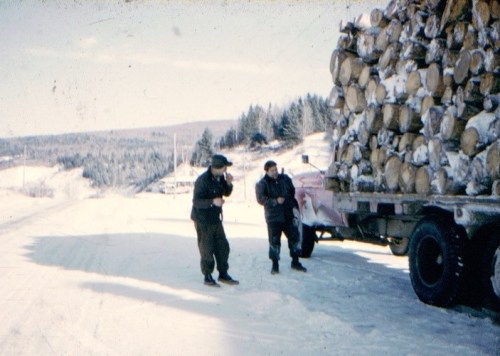
Updated 11/13: Uncle Clayton hauling pulp near St. Francis

Phillip Thibodeau (left) and Clayton Jandreau.

Phillip Thibodeau (left) and Clayton Jandreau standing near a truck hauling pulp.

I knew this day would come – a correction. Mickey Thibodeau took the photo of my Uncle Clayton Jandreau next to his new truck, a 1960 model, in the winter of 1960-61 in the street in front of his family’s home not too far from where my Uncle Clayton, my Mom and their siblings grew up in St. Francis, Maine. Mr. Thibodeau’s father, Phillip, is standing with my uncle. Mr. Thibodeau did not receive the photo from my cousin.

[Posted November 12, 2009 (See correction above): I wanted to get this photo up. I will post more later on it. The photo was e-mailed to me from another Mainer “from away,” Mickey Thibodeau, who now lives in Lake County, California. Actually, the photo comes from Mr. Thibodeau who received it from my cousin Cindy Jandreau. (Yep, the moose hunter.) The photo, taken in St. Francis toward Allagash, shows Mr. Thibodeau’s father, Phillip, and Clayton Jandreau (nearest truck), an uncle to Cindy and me. I am not sure when the photo was taken, but I am guess it had to be in the 1950s or ’60s.]

As I recall from family tales, one of the things my Grandfather and uncles did to get by was cut pulp to be used in mills. They used horses to haul the pulp from the woods to sidings or the nearest road where it was loaded – I am assuming usually loaded by hand – onto a truck to be taken to the mills. Of course, pulp is used for paper and other products.

I seem to recall a story my mother told me once that one of the horses they used to haul the pulp broke loose and was racing toward my Mom, who was pretty young at the time. If I recall the story correctly, one of her brothers threw her behind a fallen tree and the horse leaped over them and the fallen tree. It must have been a pretty exciting time for a little kid.

Mr. Thibodeau also mentioned an old parish hall in St. Francis my Uncle Warren – Clayton and my Mom’s brother and Cindy the Moose Hunter’s father – own and subsequently tore down. He later built a home there for himself, his wife Monica and their children.

I seem to recall that for a time – perhaps between when the building was used as a parish hall and when my Uncle Warren tore it down – that he ran a couple of businesses, including a barbershop and a pool hall/pinball parlor. I recall seeing photos of my first haircut and I am pretty sure Uncle Warren handled the shears that day. If the photos are any indication, I was not particularly pleased to get my hair trimmed.

For those who are unfamiliar with where St. Francis is located, it is on the border with Canada near where the St. Francis and St. John rivers meet. If you look at a map of the state, St. Francis is in the large notch at the northern border. Allagash, where the Allagash Wilderness Waterway ends to the north, is east of St. Francis. Fort Kent, Maine, to the east is where I was born.

Maine a leader in reducing carbon footprint

Clean air, clean water, clean everything is what I recall about living in Maine.

After all, I grew up in a small town in northern Aroostook County where traffic congestion pretty much happened only at the local general store where locals gathered for ice, milk and gossip. Or across the street at the local motel and restaurant that catered to people from away and locals alike.

A traffic “tie-up” happened when two friends driving in opposite directions stopped their vehicles in the middle of a town street to have a conversation about work, the weather, hunting or the cost of heating fuel. Or @#%* taxes. Local motorists coming upon such a scene tended to wait patiently or toot their vehicle’s horn in hello before driving onto the gravel shoulder to get around so as not to interrupt the conversation.

In Aroostook County, there are no smog warnings or “Spare the Air” days, and usually little need to run water through a treatment plant.

But things change over time. Population increases. More people means more vehicles means more gasoline used. More people means more energy needs means more petroleum products burned to make electricity. And those things mean more harmful emissions.

So, it is reassuring – but not particularly surprising given the type of people Mainers are – that a report released today shows that Maine is a leader when it comes to reducing its carbon footprint. That – and the state’s efforts in obtaining energy from alternatives such as wind and wave power – provides hope for sustainability in the long run in meeting energy needs through clean energy sources. And it means reducing greenhouse gases that help cause global warming.

The study – an analysis of U.S. Department of Energy data – shows that Maine’s carbon footprint was reduced by a larger proportion than any other state from 2004 to 2007, according to a Portland Press Herald story by staff writer John Richardson. Maine is leading the national trend for that period by dropping by 15 percent the carbon dioxide emissions from the burning of coal, oil and gas, according to the report by the Environment America Research and Policy Center.

That is a good start. But there is so much left to do.

Environmental advocates and state officials say those emissions still have to drop a lot lower in Maine and elsewhere in the United States to avoid such climate changes as rising seas and warmer, wetter weather.

“While that’s great, it’s also not enough. We need to keep going,” Katie Kokkinos, an advocate with Environment Maine, is quoted in the story. “The overall picture is, yes, we’re taking initiative and moving forward, but it’s still too slowly.”

Granted, there are other influences at work her, including the economic influences of higher oil prices.

But every effort toward the overall goal of global survival is well worth it and one part of that is reducing carbon dioxide emissions.