I spotted the following on Texts From Last Night and it made me grin.
“Just a heads up. Everytime I get arrested in Maine I claim I lost my ID and use your name.”

I spotted the following on Texts From Last Night and it made me grin.
“Just a heads up. Everytime I get arrested in Maine I claim I lost my ID and use your name.”
It must be the triple-digit temperatures that regularly hang over the San Joaquin Valley like a hammer against white hot steel just pulled from the forge.
Or perhaps it is because I was born on the first day of summer, the longest day of the year, the summer solstice.
Or perhaps it is because I grew up in the frigid expanse of the Deep Dark North Woods of Maine and it will take a lifetime – or longer – for all of me to thaw.
It really doesn’t matter. I’ve been thinking about summer quite a bit lately. More specifically, I’ve been thinking about the summers of my youth. And local lore.
Even before teachers started talking about summer reading lists and vacations of which they so longingly and protectively spoke – they always seemed to have a look in their eyes that spoke of the anguish that came with the long, long academic year – it was time to crank up Alice Cooper’s “School’s Out.”
In case you forgot, here are the lyrics to that lovely tune.
Well we got no choice
All the girls and boys
Makin’ all that noise
’Cause they found new toys
Well we can’t salute ya
Can’t find a flag
If that don’t suit ya
That’s a drag
School’s out for summer
School’s out forever
School’s been blown to pieces
And so on.
But there was much more to the summer than sitting around listening to a man named Alice.
Sure, there were summer jobs and chores and that sort of thing. Summer school for some; summer camp for others.
And, occasionally, the dreaded family vacation. Being cooped up in a car for hours upon hours was no way to spend a summer vacation.
But there was so much more about summer than those things.
There were pickup games of baseball and basketball. There was golf. There was swimming and canoeing and sailing. There were barbecues. There were Red Sox games on the black and white TV. And more.
There is something special – mystical, even – about those summer days of youth. Days of personal and community lore, if nothing else.
Portage Lake is nestled among hills and mountains of central Aroostook County. State Route 11 winds its way from the south over a hill and down into the flatland where rests the town – Dean’s Motor Lodge, Coffin’s General Store, the post office, a few more businesses, and homes for several hundred residents.
Except for the public beach, the seaplane base, and the Forest Service facility, year-round homes and vacation cabins are sprinkled on the wooded hills and flats that make up the shore of Portage Lake.
The ancient hills for the most part are gentle and worn down over millions of years of shifting plates, pounding rains, persistent winds, and – a late-comer to the wear and tear – man and machine.
A contrast is an outcropping of earth and rock – very probably New England granite – that overlooks the water and town from just east of the lake.
Every community has lore. Some of it is good. Some of it is not so good. Some of it is simply neutral. Local lore many times sprouts from older children trying to impress younger children, the local lore that includes stories to scare younger children. It’s the lore passed down from generation to generation to generation of the people who are born, live and die in such places as this.
Part of the lore of Portage is a slab of stone known among generations of Portage school-age children as Secret Rock.
There was never any treasure or tragedy associated with Secret Rock, at least none that I recall these many years since. No pirates or other scallywags buried booty near Secret Rock. And no love-struck, lovesick couple ever took a plunge from Secret Rock.
There were no frightful creatures hiding in the cracks and crevices of the quartz-injected granite, no monsters hiding in the nearby forest. It was simply a rock, a rock not much larger than a tennis court, as I recall.
Frankly, there wasn’t much “secret” about Secret Rock. I could see Secret Rock from my childhood home, especially in fall and winter when the trees were free of leaves. And there were times when ant-size figures could be spied crawling up the face of the steep trail that led to Secret Rock.
Perhaps the secret was the one most children kept from their parents when it came to potential peril. After all, the trail up to Secret Rock was steep and children of a certain age did not tag along because they could not make the climb.
The climb also could not be made in winter. Snow and ice covered the rock and the trail leading up to it.
Climbing to Secret Rock was a summertime activity.
But it was the lore of the land and climbing the slope to Secret Rock was a rite of passage for generations of Portage Lake children.
Not far beyond the rock – at least, not far as I can recall – was another steep climb and the road that led to the local golf course with its holes set out along the hills just beyond the town.
It was an adventure for children to climb to Secret Rock and not much of an added strain to continue on to Portage Hills Country Club.
We all need local lore.
It is part of regional lore and national lore and global lore. It helps bind us a community. It solidifies shared memories of our youth. It gives us a common ground and reminds us that our differences, no matter how massive, how divisive, can never defeat us if we hold to local lore and all that it represents.
We all need local lore. We all need our Secret Rocks.

There are several ways to have Maine-style lobster. The postcard version, of course, is to boil up some water over an open fire on a beach and serve with steamed clams, fresh corn, and lots and lots of butter.
Another Maine style is to set up a newly purchased Coleman camp stove on the driveway of your sister’s Fryeburg home, boil some water, and light up a cigar.
That’s right, light up a cigar.
The last time I visited family in Maine, that’s what happened.
My mother and I had traveled from her home in Aroostook County where I was visiting and we stopped along the way at the Bangor Walmart to pick up the stove. I cannot recall exactly the occasion for the purchase. It might have been a wedding anniversary gift for The Sis and Brother-in-Law Mark.
No matter.
Lobsters were purchased and the water was set to boil on the camp stove set up in my sister’s driveway. (My sister did not want the smell of lobster to linger for days and days in her fairly new home.)
My sister’s home is set back in the woods outside of Fryeburg with plenty of nooks and crannies and ponds and leaves and blades of grass for mosquitoes to flourish. I describe Maine mosquitoes and blackflies this way to my friends “from away” – the mosquitoes and blackflies are so large in Maine that the Federal Aviation Administration issues tail numbers. And requires flight plans.
I do not use “swarm” often, but we were attacked by a swarm of mosquitoes shortly after starting the lobster bath.
At one point I flashed to a memory of my father and mother lighting “smudge fires” in metal barrels and buckets to ward off mosquitoes and blackflies in order to continue outdoor activities. Despite thinking that my sister or mother might object, I offered to retrieve an Arturo Fuente cigar from a stash I had with me on the trip and light it up to be a “human smudge fire.”
“Yes, go! Go get a cigar!” I seem to recall my sister saying.
“Yes, Keith, go!” my mother added. (At least, that’s what I recall now them saying then. I could be wrong.”
So, there I was, standing in my sister’s driveway overseeing the cooking of the crustaceans with a stogy sticking out of the corner of my mouth providing a smudge fire protection for my Mom, The Sis, and her family.
What started all this? The DownEast.com trivia question for the day.
How many species of mosquitoes are native to Maine?
Answer
Although sometimes it seems like millions, Maine is home to about twenty species of human-biting mosquitoes.
I am of the belief that scientists have not classified all the species for 20 seems like a very, very low number. Trust me on this.
Posted in Environment, Food and Drink, Maine, Outdoors
Tagged Aroostook County, Arturo Fuente, blackflies, cigar, Coleman propane camp stove, DownEast.com, Fryeburg, lobster, Maine, Maine trivia, mom, Mosquitoes, smudge fires, The Sis
ELLSWORTH, Maine — As conductor Gary Briggs yelled “all aboard” and passengers began to fill the cars, the train’s engine chugged to life, followed by a plume of gray smoke billowing from the locomotive stack.
The Downeast Scenic Railroad, a four-year labor of love for dozens of rail enthusiasts, made its inaugural run Saturday for volunteers and other guests who helped see the project through.
Tom Testa, president of the board of directors and the driving force behind bringing an excursion train to Hancock County, could not contain his enthusiasm. He talked passionately about the history of rails in eastern Maine and how trains brought that part of the state to the world. And he praised the collaboration of many public and private entities that made the Downeast Scenic Railroad go from dream to reality. More than 75 volunteers logged 37,000 hours clearing the abandoned tracks, repairing the rail bed and restoring old cars.
“No one person should take credit. We’ve all made this happen,” Testa said.
Click for the rest of this story by Eric Russell in the Bangor Daily News.
Tickets can be purchased at Cadillac Mountain Sports on High Street in Ellsworth or by calling 1-866-449-7345. For information about the Downeast Scenic Railroad, visit www.downeastscenicrail.org.
Posted in Entertainment, Maine
Tagged abandoned tracks, Downeast Scenic Railroad, Hancock County, locomotive, Maine, rail, rail bed
JONESPORT, Maine — This year’s wild blueberry harvest has begun and as sweet and wonderful as the little round berries taste fresh from the fields, producers are banking on capturing the frozen fruit market.
Till explained that because the berries do not get mushy or lose their flavor or healthful benefits, they have an edge over cultivated berries when frozen.
Of last year’s 88 million pounds of wild blueberries, only 600,000 pounds were sold fresh.
The remaining 87.4 million pounds were processed: sold as ingredients in muffins, ice cream and other foods.
But a new marketing campaign launched a year ago is reaping rewards, Sue Till of the Swardlick Marketing Group told more than 100 wild blueberry producers gathered this week at Blueberry Hill in Jonesboro, the University of Maine’s blueberry experimental farm.
Rather than attempt to capture the fresh market — which is already in the hands of cultivated blueberry producers in Michigan, California, New Jersey, Oregon, and a handful of other states — Maine’s wild blueberry producers are promoting frozen berries.
Click on the link for the rest of this story by Sharon Kiley Mack in the Bangor Daily News.
Maine camp plants seeds of tolerance | Lewiston Sun Journal
Learn more about Seeds of Peace at http://www.seedsofpeace.org/.
Posted in Environment, Maine, Outdoors, Politics and government
Tagged campers, Egypt, Israel, Jordan, Maine, Middle East, Otisfield, Palestine, Seeds of Peace
Posted in Economy, Energy, Environment, Maine, Politics and government
Tagged Conference of the New England Governors and Eastern Canadian Premiers, Darrell Dexter, Gov. John Baldacci, Maine, Nova Scotia, offshore wind energy, renewable ocean electricity generation, tidal energy, Tidal Energy Symposium, turbines, wind energy, wind power
The educational system in this country is letting down a lot of people. A guy in empresso just now commented on my hat – Boston Red Sox cap – and I said that I had grown up in New England.
“Oh, really! I’ve heard there’s a lot of great music in the UK.”
“No, I grew up in NEW England. Not the UK.”
“What’s the difference?”
“New England. It’s made up of the states of Maine, New Hampshire, Vermont, Massachusetts, Connecticut, and Rhode Island.”
“Oh …”
For crying out loud, people! New England and the Atlantic states are the R&D labs for this experiment called the United States of America. It is a hugely important part of this country.
Go to Coffeehouse Observer for more coffeehouse observations.
AUBURN — Spring and Rich Gouette have three kids, an 11-year-old boy and two young girls. Louise and Brian Johnson have three boys; the oldest is 6. Each family considered adoption last fall, yearning to add to their young broods, but the time didn’t feel right for either. The Gouettes had their house up for sale. Moving invited uncertainty. The Johnsons prayed about adoption, leaving the decision with God. They weren’t yet feeling called.
And then, an earthquake struck Haiti in January.
The sale of their house had fallen through and the Gouettes couldn’t see waiting any longer. They connected with a Haitian orphanage through friends and immediately fell in love with a 9-year-old boy named Augenson. He was the one.
Then came news that he wasn’t alone.
Augenson had brothers, 6-year-old Wisler and 2-year-old Wisly.
“We were just in agony: ‘How do we separate the brothers?’” Spring Gouette said. “I put the word out on Facebook, ‘Here’s the deal …’”
Click on the link for the rest of this story by Kathryn Skelton in the Lewiston Sun Journal.
Posted in Disaster, Economy, Education and Schools, Maine, Politics and government
Tagged adoption, Auburn, disaster, earthquake, Haiti, Haitian, Maine, mud pies, Port-au-Prince, quake, UN, United Nations, Wayom Timoun Orphanage

Shipyard Brewing Company is based in Portland. This evening I went with the IPA, which I do not find as tasty as the brewer’s regular Export Ale. But it was not bad, either. The Shipyard glasses were purchased a year or two ago at BevMo in Stockton. Yes, that is a lobster bottle opener in the foreground. It is also Maine stuff.
A Maine native living “away” is required by his or her nature to have around him or her things that conjure up images of Maine.
And from time to time that comes in the form of chilled adult beverages. Fortunately, BevMo, the beverage warehouse store, carries several Maine brews, including Allagash, Shipyard, and Sea Dog products.
Today’s photo of “Maine Stuff in My California Apartment” includes glasses and brew from Maine. Be assured that no beer was wasted in the making of this blog entry.
Oh, and, yes, that is a lobster bottle opener. That also falls under the category of Maine stuff.
I also included a photo of a couple of Fenway American Pale Ale pint glasses. I don’t recall ever enjoying a Fenway American Pale Ale, but I figured I’d include it because it is a New England beer and I am a Boston Red Sox fan.
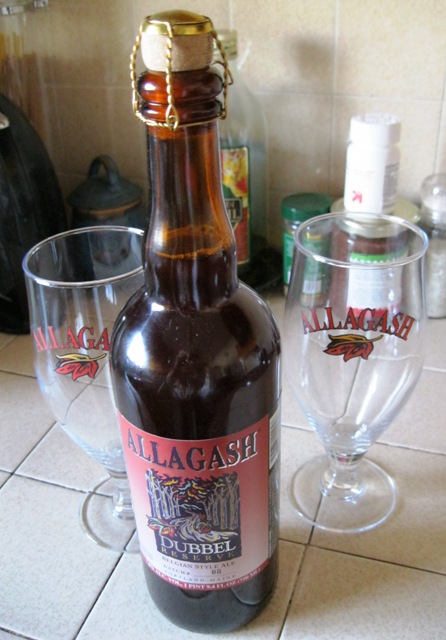
Recently had a bit of the Allagash Dubbel Reserve poured in an Allagash glass. Nice beverage. Allagash is based in Portland, Maine, nowhere near the Allagash Wilderness Waterway. The glasses were purchased a couple of years ago.
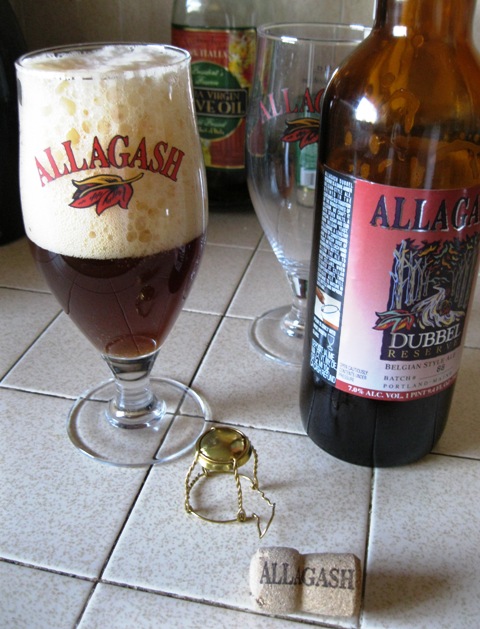
Nice head on the Allagash Dubbel Reserve. I have tried several of the Allagash offerings and have liked each of them.
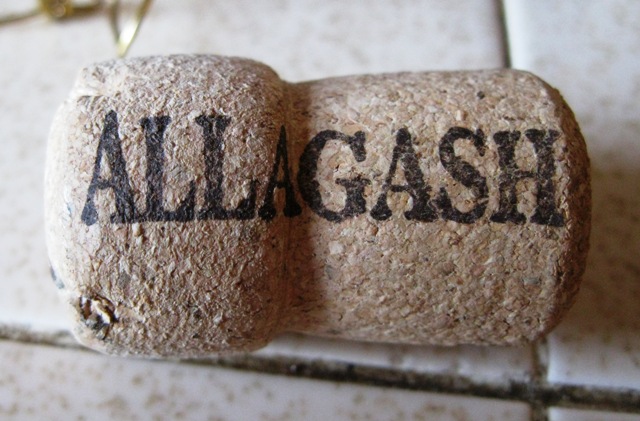
Gotta love a beer that is corked.
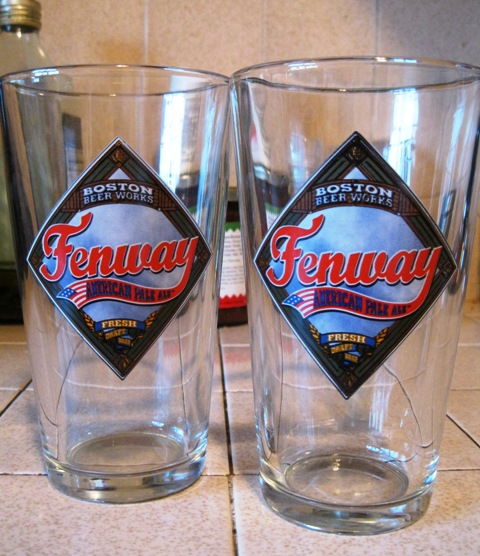
OK, so this is a photo of beer pint glasses for a beer made in Boston. But I am a Red Sox fan so I thought I would add this photo of Fenway American Pale Ale glasses along with Maine stuff related to beer.
This is an occasional multipart series of photos of things related to Maine that can be found in Keith Michaud’s California apartment. All photos in this series are shot by and are the property of Keith Michaud.
Posted in Food and Drink, Maine, Red Sox
Tagged Allagash, apartment, belongings, BevMo, brew, California, chilled adult beverages, crafted beer, Fenway American Pale Ale, lobster bottle opener, Maine, Mainer, multipart series, photos, SeaDog, shipyard


 Letters From Away