Tag Archives: Maine

Sign on door: Gone golfin’

It is unlikely that there will be anything new posted over this weekend. I received an invite to visit some friends and play some golf tomorrow. Likely will watch the Patriots play the Colts afterward.

Please feel free to look around “Letters From Away” and I will be back early next week. Enjoy!

Time of essence for Maine wilderness EMTs

I spotted a blog entry on DownEast’s website and thought it interesting. It is about rural emergency medical care and the need for certain adjustments to be made so a patient gets essential medical care in time.

It reminded me that for most of my childhood the closest thing to a doctor we had was a physician’s assistant in the next town, Ashland, some 11 miles away. I believe that is where the closest ambulance was located, too.

A doctor? A hospital? We had to go more than 30 miles past Ashland to the big city, Presque Isle.

In the city where I live now there are several hospitals and countless medical offices. You can hardly go a few city blocks without passing a medical office of some kind. The nearest ambulance may be just around the corner. Really. Just around the corner.

I do not recall ever seeing an ambulance in the town where I grew up. That does not mean there were not medical emergencies when I was a child; I just do not recall seeing an ambulance. Patients suffering from medical emergencies either waited for an ambulance to come from another community or family, friends and neighbors packed off the wound and loaded the patient into a pickup to drive them to the nearest medical care.

And I may not have heard an ambulance siren outside of Presque Isle or nearby Caribou until I went to the University of Southern Maine. Seriously.

The gist I get from the blog is that rural medical care now is far superior to what it was back then, that the men, women, training, equipment and support are all far, far better.

Even so, my city neighbors might not understand the difference between rural emergency health care and what they have come to expect from emergency medical pesonnel. The blog entry is especially interesting because it was written by a wilderness EMT on a Maine island with fewer than 100 residents. For her and other emergency medical responders in similar situations, it is not about how many blocks away the nearest ambulance or hospital might be. It is about weather – clear or gale – and tide – high or low – and about time of day – daylight so an air ambulance pilot can see to fly or night when the challenges of nighttime flying can be deadly. Waiting too long sometimes means a patient is bounced around a bit in a lobster boat chugging to mainland. It is about reminding a patient – forcefully, if necessary – that while they may feel fine now, it is essential to go before the sun goes down, to go while the tide is up, to go before the storm has taken hold and closed down chances of making the mainland for emergency hospital care that they need.

I am sure there are places in this country that are even more remote and provide emergency medical responders even greater challenges. All we can do is give them the training, equipment and support needed to do their jobs. And to remember as a patient to get into the ambulance … or lobster boat … when the EMT says to.

Updated 11/13: Uncle Clayton hauling pulp near St. Francis

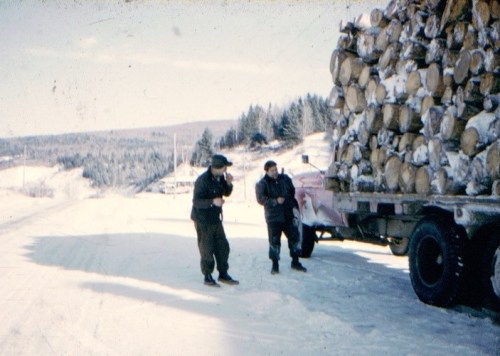
Phillip Thibodeau (left) and Clayton Jandreau.

Phillip Thibodeau (left) and Clayton Jandreau standing near a truck hauling pulp.

I knew this day would come – a correction. Mickey Thibodeau took the photo of my Uncle Clayton Jandreau next to his new truck, a 1960 model, in the winter of 1960-61 in the street in front of his family’s home not too far from where my Uncle Clayton, my Mom and their siblings grew up in St. Francis, Maine. Mr. Thibodeau’s father, Phillip, is standing with my uncle. Mr. Thibodeau did not receive the photo from my cousin.

[Posted November 12, 2009 (See correction above): I wanted to get this photo up. I will post more later on it. The photo was e-mailed to me from another Mainer “from away,” Mickey Thibodeau, who now lives in Lake County, California. Actually, the photo comes from Mr. Thibodeau who received it from my cousin Cindy Jandreau. (Yep, the moose hunter.) The photo, taken in St. Francis toward Allagash, shows Mr. Thibodeau’s father, Phillip, and Clayton Jandreau (nearest truck), an uncle to Cindy and me. I am not sure when the photo was taken, but I am guess it had to be in the 1950s or ’60s.]

As I recall from family tales, one of the things my Grandfather and uncles did to get by was cut pulp to be used in mills. They used horses to haul the pulp from the woods to sidings or the nearest road where it was loaded – I am assuming usually loaded by hand – onto a truck to be taken to the mills. Of course, pulp is used for paper and other products.

I seem to recall a story my mother told me once that one of the horses they used to haul the pulp broke loose and was racing toward my Mom, who was pretty young at the time. If I recall the story correctly, one of her brothers threw her behind a fallen tree and the horse leaped over them and the fallen tree. It must have been a pretty exciting time for a little kid.

Mr. Thibodeau also mentioned an old parish hall in St. Francis my Uncle Warren – Clayton and my Mom’s brother and Cindy the Moose Hunter’s father – own and subsequently tore down. He later built a home there for himself, his wife Monica and their children.

I seem to recall that for a time – perhaps between when the building was used as a parish hall and when my Uncle Warren tore it down – that he ran a couple of businesses, including a barbershop and a pool hall/pinball parlor. I recall seeing photos of my first haircut and I am pretty sure Uncle Warren handled the shears that day. If the photos are any indication, I was not particularly pleased to get my hair trimmed.

For those who are unfamiliar with where St. Francis is located, it is on the border with Canada near where the St. Francis and St. John rivers meet. If you look at a map of the state, St. Francis is in the large notch at the northern border. Allagash, where the Allagash Wilderness Waterway ends to the north, is east of St. Francis. Fort Kent, Maine, to the east is where I was born.

Maine a leader in reducing carbon footprint

Clean air, clean water, clean everything is what I recall about living in Maine.

After all, I grew up in a small town in northern Aroostook County where traffic congestion pretty much happened only at the local general store where locals gathered for ice, milk and gossip. Or across the street at the local motel and restaurant that catered to people from away and locals alike.

A traffic “tie-up” happened when two friends driving in opposite directions stopped their vehicles in the middle of a town street to have a conversation about work, the weather, hunting or the cost of heating fuel. Or @#%* taxes. Local motorists coming upon such a scene tended to wait patiently or toot their vehicle’s horn in hello before driving onto the gravel shoulder to get around so as not to interrupt the conversation.

In Aroostook County, there are no smog warnings or “Spare the Air” days, and usually little need to run water through a treatment plant.

But things change over time. Population increases. More people means more vehicles means more gasoline used. More people means more energy needs means more petroleum products burned to make electricity. And those things mean more harmful emissions.

So, it is reassuring – but not particularly surprising given the type of people Mainers are – that a report released today shows that Maine is a leader when it comes to reducing its carbon footprint. That – and the state’s efforts in obtaining energy from alternatives such as wind and wave power – provides hope for sustainability in the long run in meeting energy needs through clean energy sources. And it means reducing greenhouse gases that help cause global warming.

The study – an analysis of U.S. Department of Energy data – shows that Maine’s carbon footprint was reduced by a larger proportion than any other state from 2004 to 2007, according to a Portland Press Herald story by staff writer John Richardson. Maine is leading the national trend for that period by dropping by 15 percent the carbon dioxide emissions from the burning of coal, oil and gas, according to the report by the Environment America Research and Policy Center.

That is a good start. But there is so much left to do.

Environmental advocates and state officials say those emissions still have to drop a lot lower in Maine and elsewhere in the United States to avoid such climate changes as rising seas and warmer, wetter weather.

“While that’s great, it’s also not enough. We need to keep going,” Katie Kokkinos, an advocate with Environment Maine, is quoted in the story. “The overall picture is, yes, we’re taking initiative and moving forward, but it’s still too slowly.”

Granted, there are other influences at work her, including the economic influences of higher oil prices.

But every effort toward the overall goal of global survival is well worth it and one part of that is reducing carbon dioxide emissions.

‘The Way We Get By’ available online until Dec. 12

The Way We Get By - Click to Watch the Trailer

I watched the documentary last night on three of the Maine Greeters, “The Way We Get By,” and found it touching and moving. I did not mean to watch it, I just did. I fully intended to watch it online today and then perhaps comment on it later, but instead I just went ahead and watched it.

I recommend it for anyone from Maine, has been to Maine or who knows where Maine is on the map; anyone who has a veteran or serviceman or woman in their family, as a co-worker or on their block; anyone who has seniors in their family; or anyone who will become a senior someday.

It was touching to see what Tom Brokaw call “The Greatest Generation” stepping up once again to volunteer to make sure each serviceman and woman flying through the Bangor International Airport on their way to war or back again has a handshake, a hug, a cookie, a chance to use a cell phone. It is unfortunate, however, that so many – 900,000 since the Maine Greeters started their effort – have been greeted.

“The Way We Get By” is not the best documentary that I have seen, but the timing for this particular film seems right. And there are some very touching and very sad moments during the film. It is available online through Dec. 12.

OK, that is it. I promise to move on to other topics now.

Well, one more thing: I seem to recall that the Bangor International Airport was not always the Bangor International Airport. It was once part of an Air Force base and home to a fleet of B-52s protecting us from the “commie threat.”

OK, two more things: I have flown out of the Bangor International Airport and it was nice to see familiar landscape.

Another pitch for ‘The Way We Get By’

The Way We Get By - Click to Watch the Trailer

I figured I would make one more pitch for the PBS POV documentary on the Maine Greeters, a volunteer group whose members hand out smiles, handshakes, cookies and cellphones to U.S. servicemen and women going to or returning from Iraq and Afghanistan via the airport in Bangor, Maine. Day or night they are there to greet the servicemen and women.

The documentary — “The Way We Get By” — is about aging as much as it is about the servicesmen and women, because the group’s members tend to be elderly and are facing their own battles.

Check local PBS listings for times. If you miss it tonight, I believe it can be viewed on the POV website for the next month or so.

Cus brings down moose last month

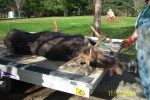
I meant to post these photos earlier, but I was still trying to figure out how to add images. Now I have that down pat (yeah, sure), so I thought I would add these photos. Click on the gallery to get a larger version of the photos. I did not want to offend anyone who is not inclined to look at photos of dead animals.

My cousin Cindy Jandreau bagged a moose about a month ago. In e-mailing photos out to friends and family on Oct. 14, she wrote: “Here are a few pictures of my moose. Got it at 7 a.m. Monday morning. (Monday was Oct. 12 and the photos seem to be imprinted with Oct. 10, but I’m guessing Monday is correct. — KM) It only weighed 650 lbs., big enough for me. I did not want to be picky, because I did not want to hunt all week.”

Well, Cindy may not be impressed by a 650-pound moose, but I am guessing most people would be. Besides, what is better than bagging game near the start of the day at the start of the week?

Cindy’s e-mail did not mention where she brought down the moose, but I’m guessing it was in northern Aroostook County.

Moose hunting was banned when I was a child and you could get into some pretty big trouble for poaching them. Now there is a lottery to get the permits and a season that rotates throughout the state. The Maine state Department of Inland Fisheries and Wildlife’s website has information on how to register for the lottery to get a license. There is also a link there for hunters interested in swapping permits.

Most of New England misses placement on this top-10 list

CNNMoney.com senior writer Tami Luhby today posted a report that much of New England – including Maine – missed being placed on a pretty unfortunate top-10 list – the top 10 states facing fiscal peril.

OK, so the story was about the top 10 and not on how much of New England missed making the list, but it is true that much of New England did miss making the list. The bottom half of the story also makes a pitch for more federal stimulus money going to states because the federal government did not realize the severity of the nation’s economic problems when the Recovery Act was passed in February.

The story reports on a Pew Center on the States’ analysis of the 50 states’ current fiscal situation based on several criteria – loss of state revenue, size of budget gaps, unemployment and foreclosure rates, poor money management practices, and state laws governing the passage of budgets.

My current home state, California, tops the list and neighboring states, Nevada and Oregon, also are on the list. Rhode Island is the only New England state on the top-10 list.

The online story also has interactive maps to show the percentage of unemployment and the percentage of foreclosures in each of the 50 states. Rhode Island, according to the maps, has 13 percent unemployment and a 7.57 percent foreclosure rate.

Of Rhode Island Luthby wrote: “The Ocean State has among the highest unemployment rates in the nation and among the highest foreclosure rates in New England. High tax rates, big budget deficits and a lack of high tech jobs are hurting its chances to pull out of the doldrums. State government has a poor record of managing its finances.” There is also a link in Luthby’s story to a previous story about the Rhode Island government avoiding closing down, never a good thing for a government.

A chart with the story indicated that the state of Rhode Island’s revenue change is -12.5 percent and the current budget gap is 19.2 percent. Seven other states on the list have a higher budget gap. (California topped that list with a -16.2 percent change in revenue and a budget gap of 49.3 percent. Yep, 49.3 percent.)

According to the interactive maps with the story, the rest of New England is faring better:

Maine: 8.5 % unemployment; 6.83 % foreclosure

New Hampshire: 7.2 % unemployment; 4.89 % foreclosure

Vermont: 6.7 % unemployment; 3.73 % foreclosure

Mass.: 9.3 % unemployment; 6.68 % foreclosure

Conn.: 8.4 % unemployment; 6.03 % foreclosure

By the way, California’s unemployment rate is at 12.2 percent and the foreclosure rate is at 10.81 percent. Nevada is at 13.3 percent and 15.62 percent, respectively. Interestingly, Nevada is the only state on the top-10 list that had a positive revenue change in the budge year – it was up 1.5 percent.

Of California Luthby wrote: “The Golden State’s housing collapse – and resulting unemployment surge – has plagued the state’s economy. The weakening economy prompted revenue to fall by nearly a sixth between the first quarters of 2008 and 2009. State lawmakers have limited ability to deal with California’s massive budget gap due to several voter-imposed restrictions, including requirements that all budgets and tax increases pass the legislature by a two-thirds majority.”

And of Nevada: “Nevada is one of the recession’s big losers as its gaming-based economy suffered. Year-over-year revenue has fallen for two consecutive years, a record. But changing tax laws is tough because some are written into the state constitution.”

I grew up in Maine’s timber belt. I suppose that is much of the state, but I am talking about Aroostook County. And I have heard that high-tech firms are moving up from Massachusetts. So, I was also interested to look at Oregon, which also made the top-10 list, because it also has a timber industry and high-tech jobs.

Luthby wrote: “Oregon’s leading industries, such as timber and computer-chip manufacturing, have been hit hard in the recession. Lawmakers have approved more than $1 billion in new taxes to keep it afloat. But voters in January will have the final say on another $733 million in new income taxes.”

Oregon’s unemployment rate is at 11.5 percent, but the foreclosure rate is a pretty low (comparatively speaking) 4.99 percent. Unfortunately, revenue change for the Oregon government is at -19 percent and the budget gap there is at 14.5 percent.

I am sure these numbers make most people’s head swim. And I know they won’t help anyone pay their bills at the end of the month. But people can look at them simply to compare where their states and regions stand compared to the rest of the country.

Maine and much of the rest of New England may not be in a great place just yet, but there are a few places worse – Michigan, California, Nevada and the rest of those states on that top-10 list. Maybe optimism born from that fact will help seed economic growth in New England.

Maine Greeters documentary tonight

The Way We Get By - Click to Watch the Trailer

Here is a link to the trailer of the documentary on the Maine Greeters. Please check local listings or return to PBS’s POV website to watch it online. The story is as much about greeting the servicemen and women as it is about aging.

From California to Maine, thank you vets

Just wanted to say to every man and woman who serves in uniform or who has served in uniform – from Maine to California – thank you for your service. Your sacrifices and the sacrifices of those who have fallen are not forgotten.

As I grow older and the men and women who are called to serve seem to be getting younger and younger, I have a growing appreciation for the commitment and love of country it takes to don a U.S. military uniform. I am awed by you all.

I am also impressed by a group of people who have been there for servicemen and woman going to war in Iraq and Afghanistan, the Maine Greeters. Members – mostly elderly, some for the wars and some against the wars – have greeted servicemen and women going and returning from war at the airport in Bangor, Maine, for years and a documentary on the group is being shown tonight on PBS’s POV. Please check out local listings and check out the documentary. I believe the documentary will be online after this evening for about a month if you cannot see it tonight. The documentary is as much about aging as it is about greeting servicemen and women going to and returning from war.

Again, veterans, thank you!

Support – barely – for ‘We Support Our Troops’ plate


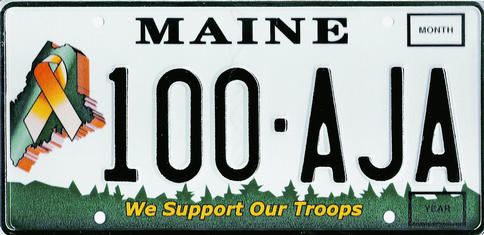
Mainers were able to purchase enough "We Support Our Troops" vehicle license plates to keep it from being retired.

 Mainers have purchased enough “We Support Our Troops” license plates – just by a hair – to guarantee the plate will be around for the foreseeable future. That is good for Maine, Mainers in uniform, their families, and veterans. 

According to a story today in the Portland Press Herald, Maine Secretary of State Matthew Dunlap said sales of the plate – which shows a yellow ribbon over an image of the state to the left of the plate number and “We Support Our Troops” over a emerald forest background across the bottom of the plate – needed to hit the 4,000 annual sales mark or the plate would be retired. The plate hit 4,017 as of Monday, according to the story by Press Herald staffer Beth Quimby.  However, the sales have not been enough to assure the plate’s long-term viability, according to Quimby’s story.  

For those outside of Maine, the standard plate carries an image of the state bird, a chickadee; I believe it is perched on the Maine state flower, the white pine cone and tassel. Two popular specialty plates include one with an image of a lobster, which is on 25,511 Maine vehicles, and the agriculture plate, which was launched the same year as the “We Support Our Troops” was launched and is on 13,250 vehicles, according to the story.Dunlap a couple of months ago warned that if sales did not pick up the plate could be retired. Military groups and some businesses got behind the sales effort. 

And why not. There are 900 or so members of the Maine National Guard – including a guy I went to high school with – who will be shipping out to Afghanistan and Iraq after the first of the year. 

A portion of the sales fee – $10 of the total $55 fee for the plate – goes to supporting families of Maine troops in Afghanistan and Iraq. So far $40,000 has been raised. “Yellow ribbon license plates play an indispensable role in supporting the military,” Capt. Shanon Cotta, spokesman for the Maine Army National Guard, said in the Press Herald story. 

There seems to be a bipartisan effort in the state to lower the threshold to 3,500 plates rather than the 4,000 limit. The lawmaker who first proposed the plate, a Democrat, has been marketing the plate to some groups – in some cases to a membership that had not known of the plate – and a Republican is working to have fellow state lawmakers lower the arbitrary 4,000 level. 

I suppose I can understand the reluctance of some Maine motorists to get the specialty plate. The specialty plate fee is $20 more than for the standard chickadee plate. A tough economy has been even tougher on small states such as Maine, so an extra $20 means more than it would some other places. And some people – for some unknown, warped reason – still equate supporting troops with supporting the war they have been sent to fight. It is not. Others might not get the plate for fear of retaliation from war protesters, the same people who equate supporting troops with supporting the war. 

The plate is good because it tells the men and women who wear the uniform that they are supported in a clear and open way. And each time they see a plate, perhaps they recall that part of the fee goes to supporting their families why they are serving the country. That is good for the morale of the troops, their families, veterans who might not have received the same support in another era, and to a public weary after years of war. 

I am not the type to put a magnetic “ribbon” on my car. I am a reserved person. (A “reserved” Mainer may be a redundancy.) But I might consider getting the plate if I wasn’t from away. 

Today is the Marine Corps birthday. Happy birthday! 

Today is also the day the nation mourns those killed at Fort Hood, Texas. A nation grieves and shares in the loss. 

And tomorrow, Nov. 11, is Veterans Day. This would be a good week for a Maine motorist to purchase a “We Support Our Troops” plate, not to support the war, but to support the soldiers, seamen, airmen, Marines, and Coast Guardsmen who serve. 


Tune in to ‘The Way We Get By’ on Veterans Day

The Way We Get By - Click to Watch the Trailer

The Maine Greeters have offered smiles, handshakes, thanks, free cookies and cell phones to 900,000 or so servicemen and women going through the airport in Bangor, Maine, on their way to Afghanistan and Iraq. From all accounts, the simple acts of kindness, pride and patriotism mean quite a bit to the men and women the Maine Greeters see.

The son of one of the Maine Greeters, Aron Gaudet, made a documentary film on the group, “The Way We Get By,” which is being shown Wednesday – Veterans Day – on PBS’s POV. It shows what the three main Maine Greeters do for servicemen and women, but also shows a different side. One of them, a World War II vet, is a staunch supporter of the wars in Afghanistan and Iraq, while the others have their doubts. All three are facing illnesses or loneliness or simply the fears associated with growing older.

Please check local listings and consider turning on PBS on Wednesday evening. It is not about being for or against war. It is about the men and women who serve, whether they are in a uniform or offering a smile, cookie and a cell phone.

Maine’s Acadia National Park sparkles, especially in autumn

It has been years since I visited Acadia National Park on Maine’s central coast, yet the images in my mind of the place are many, crystal clear and readily retrieved.

The stark and explosive beauty of the rugged Maine coastline, the stunning grandeur of its rich forests, its dazzling colors, especially in autumn, cause Acadia National Park to be one of the most visited in the system despite being one of the smallest.

It should be high on any destination list for anyone visiting downeast.

There is plenty to do there – hiking, biking, birding, rock climbing, swimming, camping, ranger-led programs and more. It is a great place for a photographer or painter, or for a writer to find inspiration.

I found a National Geographic Magazine feature on a few of the nation’s fabulous national parks, including Acadia National Park. It includes a story, photos, map and other elements, including a list of visitor tips. Below are links to websites to get more information about helping preserve the park, park hours and fees, and a history of the National Park System and Acadia National Park.

Acadia National Park

Location: Mount Desert Island, Maine

Size: 47,000 acres

Trails: 135 miles and growing

Lakes and ponds: More than 20

Volunteers: About 3,500 perform about 40,000 hours of work each year

Named national monument: 1916, and three years later was listed as a national park, the first east of the Mississippi River.

More links

Acadia National Park: Visit this site for facts about Acadia, including current activities and trail conditions.

http://www.nps.gov/acad

Friends of Acadia: This nonprofit organization is dedicated to preserving and improving the park.

http://www.friendsofacadia.org

Bar Harbor Historical Society: Learn more about the history of Bar Harbor and Mount Desert Island.

http://www.barharborhistorical.org/index.html

National Park Service: This website gives a history of the park service with links to other resources.

http://www.cr.nps.gov/history/hisnps/NPSHistory/npshisto.htm

Fire of 1947: Read this park service summary of the fire that burned thousands of acres of Acadia National Park.

http://www.nps.gov/acad/burned.htm

Acadia Mountain Guides: Anyone planning to hone their rock-climbing skills should check out this website to sign up for courses or rent equipment. Instructions are available for rock climbers at all levels.

http://www.acadiamountainguides.com

Down East Nature Tours: Avid birders should look here to find out more about birding trips, photography tours, and camping excursions, which are available seven days a week all year.

http://www.mainebirding.net/downeast

 GORP.com: Plan your trip with tips from this website, which provides comprehensive national park information and recommendations. Participate in the Acadia online forum to get first-hand reviews from other visitors.

gorp.away.com/gorp/resource/us_national_park/me_acadi.htm

American Park Network: Research the history of Acadia National Park, discover things to do, and locate lodging options on this website. Be sure to click on “Just for Kids” to learn about child-friendly activities.

http://www.americanparknetwork.com/parkinfo/ac/activities/activities.html

Maine voters pass medical pot law unlike California law

With all the noise about Question 1 on the Maine state ballot earlier this week, I forgot to mention that voters also passed a law making Maine the fifth state to allow retail medical pot dispensaries.

The vote when 59 percent to 41 percent.

Supporters claim the Maine law will not turn the state into the “Wild West” as they say it has in Los Angles where there are an estimated 800 dispensaries, not all of which are selling their product to the ill as the California law is intended. Maine law enforcement officials, of course, say there was not enough in the way of oversight and controls in the referendum.

Maine Drug Enforcement Agency Director Roy McKinney told the Associated Press, in a story published yesterday in the Bangor Daily News, that the potential exists for a dispensary to become “nothing more than a storefront for the criminal activity of drug dealing, which is the experience in California.”

 “If there isn’t sufficient oversight, inspection, audits, etc., the potential is there for criminal activity to flourish,” he said.

Ethan Nadelmann of the New York-based Drug Policy Alliance doubts Maine will have the same problems found in California. The Maine state government must license a dispensary, which California law does not require. And the Maine law narrowly defines the illnesses for which marijuana can be prescribed, while California doctors have broader latitude in recommending pot’s use.

“You aren’t going to see hundreds of dispensaries popping up all over Maine,” Nadelmann said. “You’re going to see a more regulated system.”

My experience is that law enforcement tends to overstate such pronouncements. My experience is that “advocates” also tend to overstate counter-pronouncements, so it is usually a tie.

Others said the dispensaries in Maine most likely pop up in the more liberal areas – such as Portland, Maine – than more conservative areas.

By the way, Colorado, New Mexico and Rhode Island are the other three states that allow for dispensaries.

Maine has allowed the use of medical marijuana since 1999, but did not provide for dispensaries. Patients suffering from the effects of cancer, AIDS and other really awful diseases could possess a couple of ounces of the drug and a half dozen plants.

I have written this before elsewhere, so it should not come as a surprise what my feelings are. If a family member was suffering from the ravages of cancer, AIDS, multiple sclerosis, whatever, I would do what I could to ease that suffering. And if pot was the answer, then pot is what they would get, whether there was a law to prevent it or not.

I was proud of Maine voters when they allowed the use of medical marijuana by seriously and terminally ill patients. Having dispensaries makes sense.

Homeless, hungry may have tough winter from Cali to Maine

It is not a long stretch to believe that the poor, hungry and homeless from Maine to California will have a rough winter because there are just fewer people able to give a buck here and there to charities trying to help a growing legion.

I think I got small peek at that image as I came out of a Target store in Stockton, Calif., last night. Just outside the door was a man collecting for some charity. I have seen him there before, but the hand-lettered sign always threw up a red flag for me so I nodded at him, glanced to the ground and picked up my pace as I walked to my car.

But as I neared it, a man perhaps in his 60s or 70s and weighing in at about a buck and a quarter, approached. He was wearing faded jeans, a tattered baseball cap and a sweatshirt not thick enough to ward off the chill of the November night. He had a worn and worn out quality.

I do not recall what he muttered to me, but I could tell he was asking for money. I told him that I could not give him anything; I did not bother to tell him I had been laid off for the past nine months and that I was at Target to get just basics, including a couple of candles to use at night to help keep down the electricity bill.

The guy – he may have glanced at the two bags I was carrying or just at his feet – apologized again and again for having asked me for a couple of bucks and shuffled off. I got into my car, started the engine and glanced over to see the wisp of a man bending at the waist to talk to someone sitting in a car; he was asking the occupants for a couple bucks, too. Again, no luck.

I feel horrible that I could not give him a few dollars, but I have not seen a paycheck in a couple of months and money is tight. (Please, friends, do not send money; “money is tight” is far from having no money at all. I am getting by on a shoestring and a prayer, as they say, but I am getting by. For now.) I just do not have the money to give to complete strangers. I know that sounds cold, but …

After I got back at my apartment I thought about getting back in my car and driving back to the Target parking lot to find the guy and give him a buck or two, money I could not really spare. Or a meal. But I did not.

I never have been big on giving money to panhandlers, especially since one sort of burned me last year. A guy stopped me as I was driving out of the very same Target’s parking lot and gave me a story about his car being out of gas and being unable to drive his family back to his Tracy home. I gave the guy a $5 bill and thought nothing of it. Until months later when the very same guy stopped me in another nearby parking lot and gave me the very same sob story. I told him that I recognized him and that he had given me the very same story about six months earlier. He denied it at first, but then quickly walked away and out of the parking lot. I suppose he thought I would call the police on him.

I am pretty sure the fella last night was not a professional panhandler like the guy from a year ago. That makes me feel worse for not digging into my pockets for a couple of crinkled bills.

Or he could have been just better at his con.

For years I used to send monthly checks to Habitat For Humanity. It was not about the religious message of the group, but the whole idea of giving worthy needy families a roof over their heads. I stopped sending money to the organization when things got a bit tight financially a couple of years ago. I later got a new job that paid better and I could have restarted the donations, but I did not. I do not know why, I just did not.

It is likely that charitable nonprofit organizations will continue to have a problem rising funds the rest of this year and into the next. Unemployment still remains high and many businesses remain at the brink of failure, meaning that individual and corporate giving likely will be lower than normal.

Once I get a new job and get back on my feet I will be more willing to find a way to give to a nonprofit or volunteer for an agency. At least, I hope I will.

Since being laid off I have looked for work in a couple of different fields, including for nonprofits. I have been visiting Idealist.org and other nonprofit job websites every other day or so to check job postings. I also have read some of the online articles on the website and a few months ago bought and read “The Idealist.org Handbook to Building a Better World: How to Turn Your Good Intensions into Actions that Make a Difference.” It has not made me into a bleeding heart, but the past couple of months have made me realize that I want to make something better of all this, even in a very small way. I am not sure how – yet.

Giving a few bucks to a panhandler may help that person in the short term, but there may be other ways to help by giving money, in-kind donations or time. This is how you can help if you are able:

Maine Attorney General: Get some tips on making donations before giving money, in-kind donations or time. Always check out a charity before giving money, property or time.

Charity Vault: It provides links to charities based on categories and communities. Be sure to check each charity before giving money, property or time.

Maine Charity Network: This is another clearinghouse of links to charities, most of which are global. This might not be the best place to look if you are looking to give locally.

Idealist.org: This is, according to its website, “an interactive site where people and organizations can exchange resources and ideas, locate opportunities and supporters, and take steps toward building a world where all people can lead free and dignified lives.” It is a very good spot to start. Search “maine” and links to more than 500 organizations pop up.

Maine voters narrowly repeal same-sex marriage

Supporters of same-sex marriage may be tending to wounds today after voters in Maine narrowly repealed earlier legislation that gave gays and lesbians the right to marry.

But after they pick themselves up and dust themselves off, they should look to build on the positives that came from the campaign for equality for gays and lesbians. This was merely one of many battles to be waged and one day gays and lesbians will be given the same rights associated with marriage that heterosexual couples enjoy.

The Portland Press Herald is reporting on its website that unofficial results show that voters on Tuesday approved Question 1 on the Maine state ballot by 53 percent to 47 percent. The Yes on Question 1 camp did not receive a mandate and they came close to losing in their bid to back discrimination.

Same-sex marriage supporters are vowing that they are in the fight for the long haul. While this loss is a setback, they intend to continue the fight for civil rights and equality. And they should.

The Maine State Secretary of State website does not seem to have the results posted, yet, but I am not surprised the results were so close. Mainers take their voting seriously; voting turnout was expected to be more than 50 percent. That is not bad at all for an off-year election.

Maine voters are cautious and conservative, but hugely independent by nature. Many of them may have been swayed by arguments from either side of the issue. They also may have been put off by state lawmakers and Maine Gov. John Baldacci for passing and signing the law in the first place, not because of the law itself, but because lawmakers had the audacity to pass and sign the law. I may be well off the mark, but Mainers might have been far more willing to let same-sex marriage stand if the law had come as a citizen-back referendum rather than from the state Capitol in Augusta.

It will be interesting to see how this issue continues to play out and what influence it has on the rest of the nation.

Same-sex marriage issue drives Maine voters to polls

Here is a link to the latest update on the election in Maine where a ballot issue could confirm earlier legislative action giving same-sex couples the right to marry or, if Question 1 on the ballot is passed, kill same-sex marriages in Maine.

The Maine secretary of state told the Portland Press Herald more than 50 percent of the state’s voters were likely to turn out for the election. Most of that very impressive turnout, he told the Press Herald, has to do with the same-sex marriage issue.

Note: Just a reminder that the time stamp is for Eastern Standard Time.

Maine man hunting eight decades gets his first moose

The story in yesterday’s Lewiston Sun Journal about Mr. Eugene Dackmine lends support to the positive influences of outdoor life on longevity.

Mr. Dackmine, who will turn 92 next week, last month bagged his first moose in 82 years of hunting. And the Lisbon, Maine, man got a turkey a week later. That’s all rather impressive.

I am not a big hunter, but bagging a moose might be fun. My cousin Cindy got one a few weeks ago. If I was up to speed already, I would post the photos she e-mailed to family and friends. She was disappointed that it weighed only 650 pounds. That’s rather impressive, too.

I am not sure if there is a solid connection, but read my moose story. The town where I grew up had a railroad landing and the freight train would come around the lake to transport products to and from the nearby lumber and pulp mills. And every so often a moose would attempt to stand its ground against a locomotive.

Moose are big, powerful animals, but are not particularly near the top of Mother Nature’s intellectual food chain. Moose typically are a few pine cones short of an L.L. Bean decorative seasonal basket, if you know what I mean. Believe it or not, they always seemed to fail in the train vs. moose matchup. Go figure.

As I recall, the regional game warden, who lived just down the hill from where I grew up, would be dispatched to collect a moose hit by a train. His wife used to work as a teacher’s aide and in the cafeteria of the school.  A day or so after the moose had been collected, the lunch menu at the school always seemed to include a deliciously meaty stew.

Now, I am not saying absolutely for sure that the stew contained moose, but if it was moose – and all these years later, I have to believe that it was – the meat was very, very tasty.

Congratulations to Mr. Dackmine.

The ferocious flying black fly fleet of Maine

The state bird of Maine is the black-capped chickadee, but it really, really should be the black fly.

I am not talking your average, run-of-the-mill annoying housefly here, partner. I am talking a swarming, diving, ravenous fleet of which there is no parallel and no match. A squadron of Maine black fly has been known to carry off farm animals and lay waste to whole communities. I kid you not.

I have long advocated that the Federal Aviation Administration require the Maine black fly to paint indentifying N numbers on the sides of their bodies.

And file flight plans.

As I have told my California friends for years, I grew up in the Deep Dark North Woods of Maine. To get there required trains, stage coaches, dog sleds and numerous portages. And in that wilderness I lost more than a pint of blood to those flying piranha.

Anyway, in seeking out other blogs about Maine, I came across the website for the Maine Blackfly Breeders Association. The group’s motto apparently is “We breed ’em, you feed ’em.” Or it may be “May the swarm be with you.” The group seems to have more than one motto.

The members of the Maine Blackfly Breeders Association – MBBA to those in the black-fly know – are quite serious about what they do. They have activities, legislation, a song, an online store and an annual convention. Yep, they have an annual convention. They have had 11 of them so far, with the most recent back in February. And the notice promised it was “going to be a fun beat-the-winter-blues, crowd-pleasing time.”

I am sorry I missed it.